

The first eleven chapters of Genesis, known as the Primeval History, establish the cosmic and global foundations of reality.
While these chapters reveal a Creator of absolute order and intent, they also document the primary source of human failure: the entry of a deceiver who twists truth to draw human worship away from Yahweh and toward the self.
This adversarial strategy is not merely an ancient relic but a persistent spiritual reality that requires the specific solution found only in the person of Jesus Christ.
The Architecture of Order and the Invitation to Life
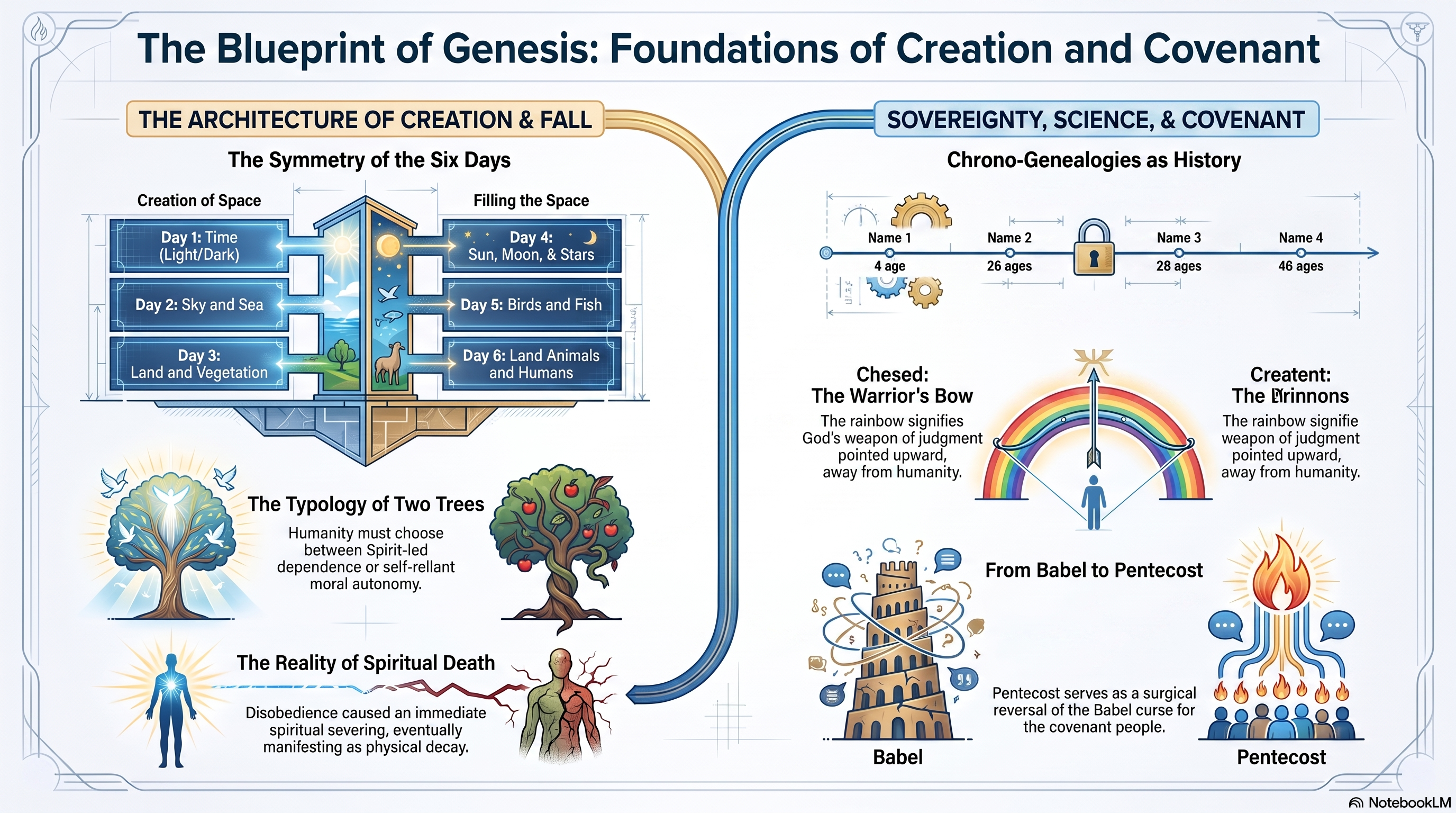
In Genesis 1, Yahweh is revealed as the sovereign Architect who methodically subdues chaos, shaping realms of Time, Sky, Sea, and Land before filling them with life.
He exists entirely outside of time, inserting light into a default state of darkness to kickstart the cosmic clock.
Genesis 2 zooms in on Day Six, revealing that humanity’s spiritual reality is centred on two trees: the Tree of Life and the Tree of the Knowledge of Good and Evil.
The Tree of Life represented a life of total dependence on the Spirit of Yahweh.
In contrast, the Tree of Knowledge represented moral autonomy, humanity’s desire to decide for themselves, independent of God, what is right and wrong.
This choice of self-reliance over divine intimacy is the very mechanism the deceiver exploits to induce spiritual death, which is the state of being severed from the life-giving Vine.
The Anatomy of Deception: Shifting the Focus to Self
Genesis 3 exposes the “weaponry” of the adversary: syntax and the twisting of truth.
Satan did not launch a frontal assault on God’s existence; instead, he used subtle linguistic shifts to dismantle the relationship between the Creator and humanity.
He swapped the personal, covenantal name Yahweh for the distant title Elohim, reframing the relational Protector as a restrictive authority figure.
By twisting a massive permission (”eat of every tree”) into a restrictive prohibition (”did he really forbid you?”), the deceiver forced Eve’s focus onto the single boundary, blinding her to the abundance of the Tree of Life.
He specifically targeted the one who was “one step removed” from the original auditory command, exploiting a structural gap to introduce doubt.
This strategy of twisting truth at will to centre on human desire rather than divine command is the hallmark of the adversarial spirit.
The Illusion of Neutrality and the Rise of Defiance
The narrative continues to show that there is no middle ground or neutral territory for the human will; it is always “owned” by a master.
In Genesis 4, Cain, though a worshiper of Yahweh, revealed his true deity was himself when his sacrifice was rejected.
By giving in to envy, Cain became the “hands and feet” of the foundational lie, actively manifesting the will of an adversarial spirit. This led to the birth of human-built cities, which represent humanity’s attempt to find security and identity apart from God.
This spirit of defiance escalated in Genesis 6 with a systemic attempt by the “Watchers” to pollute the human genome and block the promised “Seed” of the woman who would eventually crush the serpent’s head.
The Ark served as a genetic sanctuary, a sovereignly protected vault for an untainted line of humanity.
In Genesis 10 and 11, the deceiver’s influence is seen in Nimrod, the archetype of the flesh.
Nimrod’s name and actions in building Babel represent “open defiance” to Yahweh, attempting to centralise human strength and “make a name” for humanity rather than relying on the Spirit.
This “Nimrod mindset” of seeking earthly security and religious legalism is the root of lukewarmness, where human effort is substituted for the power of God.
The Sovereign Counter-Move: Preservation and Reversal
Throughout this history, God maintains monergistic sovereignty, acting alone to save despite human failure.
Genesis 5 shows God overriding the curse of death through Enoch, a forerunner for the ultimate victory of Christ over the grave.
Genesis 7 and 8 document the literal de-creation and re-creation of the world through the Flood, a judgment that serves as a scientific mechanism for rapid burial and a “hard reset” for the earth.
Genesis 9 establishes the Chesed (unconditional covenant loyalty) of God, symbolised by the rainbow, a warrior’s bow pointed toward God Himself, signifying He would take the arrow of judgment upon Himself.
Genesis 11 records the confusion of languages, a curse that was later surgically reversed at Pentecost (Acts 2) to reunite the fractured tribes of Israel under one name: Jesus.
The Theological Takeaway: The Only Solution
The history of Genesis 1–11 demonstrates that when humans focus on their own interests, autonomy, or “the things of man,” they inevitably fall under the influence of the deceiver.
This is perfectly exemplified in the New Testament when Jesus admonished Peter (Matthew 16:21-23). When Peter tried to prevent Jesus from going to the cross, Jesus identified the source of that thought as Satan, because Peter was “setting [his] mind not on the things of God, but on the things of man.”
The primeval history shows that humanity continually tries to build “mini-Babels” of human effort.
However, the only solution is the one Jesus expressed in Matthew 16:24-28:
Matthew 16:24-28 LSB Then Jesus said to His disciples, “If anyone wishes to come after Me, let him deny himself, and take up his cross and follow Me. (25) “For whoever wishes to save his life will lose it; but whoever loses his life for My sake will find it. (26) “For what will it profit a man if he gains the whole world and forfeits his soul? Or what will a man give in exchange for his soul? (27) “For the Son of Man is going to come in the glory of His Father with His angels, and WILL THEN REPAY EACH ONE ACCORDING TO HIS DEEDS. (28) “Truly I say to you, there are some of those who are standing here who will not taste death until they see the Son of Man coming in His kingdom.”
Just as Adam and Eve had to choose between the Tree of Life and the Tree of Autonomy, we are called to deny the “Nimrod mindset” of self-worship and surrender our will to the Creator.
True life is not found in physical lineage or human strength, but in spiritual rebirth through Jesus Christ.
The sovereign God who “shut the door” of the Ark to protect His remnant is the same God who calls us today to get “out of the stands and onto the field,” repenting and believing in the finished work of Jesus as our only hope.