
The Opinions of Men
From the Scales of Nicaea to the Pale Horse of Papal Hegemony, and the Divine Answer Out of the Whirlwind

The question posed by the adversary, “Did God really say….?”, remains an eternal fixture in the hearts of men and women who strive for human consensus.
The opinions of mortal men concerning God are as infinite, shifting, and unstable as the grains of sand on the seashore.
Yet, throughout church history, humanity has succumbed to a recurrent delusion: the belief that through philosophical debate, political compromise, and committee consensus, finite minds can measure, weigh, and codify the Infinite, the unfathomable.
Scripture leaves no ambiguity regarding who builds, defines, and seals the faith of the believer.
Yet, the prophetic timeline of Revelation foretold an era when direct revelation would be eclipsed by human debate, paving the way for spiritual famine and institutional death.
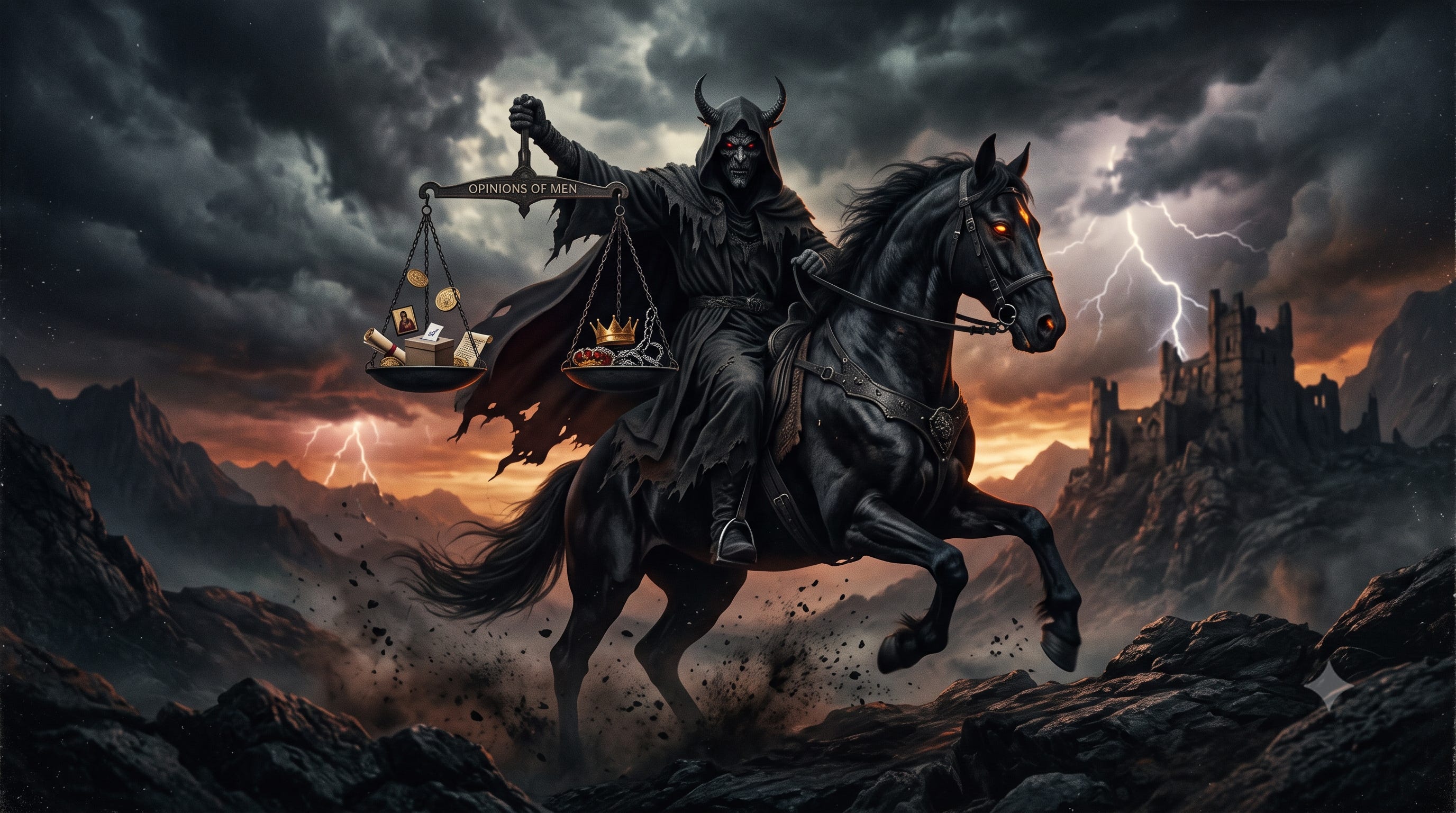
To understand how Christendom fell into centuries of darkness, we must re-examine the vision of the Third and Fourth Seals and behold the fateful hour when the opinions of men were placed on the scale.
I. The Third Seal: The Black Horse and the Scales of Consensus
In Revelation 6, the juxtapositional restatement of the overall story of spiritual decay in the Church Age, a striking progression unfolds before the Apostle John.
Following the apostolic purity of the White Horse and the blood-soaked persecution of the Red Horse, the Third Seal unveils an entirely different threat—one that attacks the Church not from without, but from within.
When the Third Seal is unsealed, John beholds a black horse whose rider carries a pair of scales (or balances) in his hand. A voice amongst the living creatures proclaims a decree: a quart of wheat for a denarius, and three quarts of barley for a denarius, while commanding that the oil and the wine remain unharmed (Revelation 6:5–6).
While traditional commentaries frequently restrict this vision to economic inflation, the deeper prophetic typology points directly to the spiritual state of the Church during the Council Era (4th to 6th centuries).
The colour black represents the darkening of spiritual discernment. The rider holds a pair of balances, the universal symbol of weighing, measuring, debating, and trading.
This was the era of theological bargaining.
Divine revelation was no longer accepted as absolute and self-authenticating; instead, it was placed on the scales of human philosophy and evaluated by the weights of political expediency.
The result was a severe spiritual famine. Wheat and barley, the essential grains that sustain life, were rationed at extortionate prices. A full day’s wage for a Roman labourer could purchase only a single quart of wheat. The Word of God, once freely given to all, became an expensive commodity, parsed out in meagre, highly technical fragments by elite councils and theologians.
Yet, the divine decree remains: do not harm the oil and the wine.
Even in the darkest hours of human debate, when men sought to weigh God’s truth on their own artificial scales, the essential anointing of the Holy Spirit (the oil) and the redeeming blood and grace of Jesus Christ (the wine) remained uncorrupted, preserved by God beyond the reach of human manipulation.
II. The Political Canvas: Constantine’s Imperial Machine
The primary historic fulfilment of this weighing scale occurred in AD 325 at the city of Nicaea (modern-day İznik, Turkey).
To comprehend the Council of Nicaea, one must look past pious retellings and confront the stark political realities of the 4th-century Roman Empire.
Emperor Constantine had successfully consolidated power, uniting the Western and Eastern halves of the Roman world under his sole authority. Having adopted Christianity as the ideological engine of his empire, Constantine envisioned a unified Church serving as the civic cement of Rome. However, upon turning his gaze to the East, he was alarmed to find a Church violently fractured by doctrinal warfare.
The Imperial Imperative
Constantine was an emperor first and a theologian second. His paramount objective was pax imperialis (imperial peace). A fractured Church meant a fractured empire. Constantine did not assemble the bishops to discover divine truth; he summoned them to force a visible, legal consensus that would secure his political stability.
Utilising the state’s imperial post system (cursus publicus), Constantine financed and summoned over three hundred bishops to his summer palace. For the first time in history, an autocrat presided over an ecclesiastical council, sitting upon a golden throne at the centre of the hall. The imperial state had officially stepped in to manage, direct, and enforce the “opinions of men.”
III. The Protagonists: Philosophical Friction at Nicaea
At the heart of the Nicaean debate were three distinct factions, each representing human logic attempting to articulate the incomprehensible relationship between God the Father and God the Son.
1. Arius of Alexandria (The Rationalist)
Arius, a popular presbyter from Alexandria, approached theology through the lens of strict Aristotelian logic and Hellenistic philosophy. Desiring to protect the absolute transcendence and oneness of God the Father, Arius insisted that a father must chronologically precede his son.
Thus, he argued that Christ was a created being, exalted above all creation, yet non-eternal. His catchphrase echoed through the ports of the Mediterranean: “There was a time when He was not.”
Arius’s opinion appealed to human reason because it fit cleanly into Greek metaphysical frameworks.
2. Athanasius of Alexandria (The Defender)
Opposing Arius was a young deacon named Athanasius. Small in stature but relentless in resolve, Athanasius recognised that if Christ were a created being, his death on the cross could not accomplish true divine redemption.
Only God Himself could bridge the infinite chasm between Creator and creation. Salvation required that Jesus Christ be fully, eternally, and unalterably God, uncreated and co-eternal with the Father.
3. The Centrist Factions & Imperial Compromise
The majority of bishops sat between these two poles, desperate to avoid schism and satisfy the Emperor.
To break the deadlock, the council introduced a word that appears nowhere in the biblical text: Homoousios (consubstantial, or “of the exact same substance”).
Athanasian / Orthodox - Homoousios, Christ is of the same substance as the Father, Adopted into Official Imperial Creed
Moderate / Semi-Arian - Homoiousios, Christ is of similar substance to the Father, Rejected as an unstable middle ground
Arian Faction - Anomoios, Christ is of different/unlike substance, Condemned; Arius exiled by Imperial decree
While the Council of Nicaea ultimately affirmed a vital biblical truth of the full deity of Christ, it established a dangerous, unbiblical precedent: truth by committee, defined by non-scriptural philosophy, and enforced by state violence.
Banishment by imperial decree became the punishment for failing to sign a humanly constructed creed. The scales of the Black Horse were in full operation.
IV. The Fourth Seal: The Pale Horse and Papal Hegemony
The tragic momentum of history does not stop at the Third Seal.
When divine revelation is traded for human opinion, spiritual decay is the inevitable harvest. In Revelation 6:7–8, the Lamb opens the Fourth Seal, revealing a pale horse whose rider is named Death, followed closely by Hades. They are granted authority over a fourth of the earth to destroy by sword, famine, plague, and wild beasts.
The Greek word translated as “pale” is chloros—the sickly, ghastly greenish-yellow tone of decomposing flesh. This is the colour of institutionalised spiritual death.
As the Roman Imperial machine collapsed, the institution of the Roman Papacy rose to inherit its power.
The precedent set at Nicaea, where human councils and political rulers defined and enforced faith, morphed into a total spiritual monopoly.
In 538 AD, with the elimination of the Ostrogoths as the final blockage to the institutionalised church’s absolute power, the Papacy declared its bishop to be the supreme Vicar of Christ, placing human tradition, papal bulls, and ecclesiastical dogma above or equal to the Holy Scriptures.
For 1,260 years, the Pale Horse rode across Christendom until in 1798, Napoleon’s General rode into Rome and cancelled the Pope’s authority, kidnapping him to France (the mortal wound of Revelation 12).
The four judgements of the Fourth Seal manifested in stark historical reality:
The Sword: The ruthless suppression of dissenters, the brutal massacres of early reformer groups, and the horrors of the Inquisition.
Famine: The literal locking away of Holy Scripture in Latin, forbidding the common man from reading God’s Word in his own language under threat of execution.
Plague: The unchecked spread of spiritually deadly doctrines—indulgences, purgatory, priestly absolution, and the veneration of relics.
Wild Beasts: The corrupt alignment between ecclesiastical authority and tyrannical feudal monarchs who used religious conformity to enslave populations.
When the opinions of men replace the living Word of God, the horse is no longer pure white; it becomes sickly, pale, and dead.
V. The Divine Reality Check: Job 38
What does God think of man’s tireless efforts to weigh, measure, and debate His nature?
How does the Creator view our creeds, our political councils, and our endless theological debates?
To find the answer, we must turn to the Book of Job.
After Job and his friends spent thirty-seven chapters exchanging human opinions, philosophical theories, and pious arguments about God’s justice and character, God Himself finally intervened out of the whirlwind.
He did not join the debate. He destroyed it.
God confronted Job directly, asking who dared to obscure His counsel with words devoid of knowledge, challenging finite man to account for the creation of the world, the measurement of the earth, and the placement of its foundations (Job 38:1–5).
God’s response out of the whirlwind is a humbling rebuke to every theologian, council delegate, and pope who ever lived.
Mortal man, whose life is a fleeting mist, whose intellect is finite, and whose knowledge is derived, has zero standing to debate or adjudicate the nature of the Uncreated, self-existing God.
When three hundred bishops sat in Nicaea arguing over Greek philosophical vocabulary, God was asking: “Where were you when I laid the earth’s foundation?”
When popes issued decrees claiming power over heaven, hell, and the souls of men, God was asking: “Who stretched a measuring line across the cosmos?”
Am I not the God who never changes?
Malachi 3:6 LSB “For I, Yahweh, do not change; therefore you, O sons of Jacob, are not consumed.
Hebrews 13:8-9 LSB Jesus Christ is the same yesterday and today and forever. (9) Do not be carried away by varied and strange teachings; for it is good for the heart to be strengthened by grace, not by foods, through which those who were so occupied were not benefited.
VI. The Author and Finisher of Our Faith
Human opinion in matters of faith is built upon shifting sand.
Jesus Christ Himself warned of the folly of building one’s spiritual house upon such foundations (Matthew 7:24–27).
Matthew 7:24-27 LSB “Therefore everyone who hears these words of Mine and does them, may be compared to a wise man who built his house on the rock. (25) “And the rain descended, and the rivers came, and the winds blew and fell against that house; and yet it did not fall, for it had been founded on the rock. (26) “And everyone hearing these words of Mine and not doing them, may be compared to a foolish man who built his house on the sand. (27) “And the rain descended, and the floods came, and the winds blew and slammed against that house; and it fell—and great was its fall.”
Faith is not an intellectual construct produced by council votes or papal decree.
Scriptural faith has only one Originator and one Perfecter.
As the writer of Hebrews exhorts us, believers are to keep their eyes fixed on Jesus, who stands as the author and finisher of our faith (Hebrews 12:2).
Jesus is the chief originator and the completer of our salvation. Man adds no chapters to this book; councils sign no final edits.
The Apostle Paul reinforces this total repudiation of human wisdom in 1 Corinthians 1, noting that God has rendered foolish the wisdom of this world and that human philosophy cannot know God.
In 1 Corinthians 2:5, Paul declares the ultimate purpose of divine revelation: that our faith should not stand in the wisdom of men, but in the power of God.
Conclusion: Step Off the Scales
The lessons of Revelation 6, Nicaea, and Job 38 converge on a single, urgent call: we must step off the scales of human opinion.
The history of the Church demonstrates that whenever believers substitute human consensus, philosophical terminology, and political power for the simple, unadulterated Word of God, spiritual famine follows, and spiritual death is never far behind.
The opinions of men, no matter how exalted their titles, how brilliant their intellects, or how majestic their councils, are as incongruous to God as a single grain of sand compared to the boundless universe.
Stop weighing faith on the balances of human tradition.
Look away from the councils, away from the creeds, and away from the edicts of earthly rulers and their denominational boundaries.
Look solely to Jesus; the true, uncreated Word, the sovereign Lord of history, and the sole Author and Finisher of our salvation.
Thank you for sharing this. It was a timely reminder that our opinions, traditions, and personal preferences must always be tested against the truth of God's Word. The Bible is our final authority, not the changing opinions of men. As Isaiah 55:8–9 reminds us, God's thoughts and ways are far higher than ours. Proverbs 3:5–6 teaches us to trust in the Lord with all our heart and not lean on our own understanding. Jesus prayed in John 17:17, Sanctify them by the truth; Your word is truth. Paul also exhorted Timothy in 2 Timothy 3:16–17 that all Scripture is God-breathed and equips us for every good work. May we always have humble hearts that are willing to set aside our own opinions whenever they conflict with God's Word. Lord, help us to be people who love the truth, live the truth, and boldly proclaim the truth in love. God bless you for this encouraging reminder.