


Please stop now and read Matthew 23 (all of it) before you read this article.
The words of Jesus in Matthew 23 remain one of the most searing, unfiltered prophetic speeches in all of Scripture.
It is not directed at pagans, atheists, or the morally wayward.
It is aimed squarely at the religious establishment—those who sat “in Moses’ seat,” those who claimed to speak for God, those who believed themselves to be the gatekeepers of spiritual legitimacy.
In every generation, these words return like a mirror.
And in ours, they expose the deep fault lines of a church culture that has become institutional, self‑protective, and spiritually lukewarm—eerily reminiscent of the Laodicean church of Revelation 3.
This article explores how the woes of Matthew 23 illuminate the crisis of the modern institutional church, especially its presumption to wield spiritual authority God never granted, including the audacious claim to pronounce forgiveness of sins while remaining spiritually compromised.
The Woes of Matthew 23: A Prophetic Template
Matthew 23 is not merely a historical rebuke; it is a diagnostic tool. Jesus exposes patterns of religious corruption that reappear whenever spiritual authority becomes detached from obedience, humility, and genuine discipleship.
Key themes in the woes:
Illegitimate authority: “They tie up heavy burdens… but they themselves will not move them with their finger.”
Performative spirituality: “They do all their deeds to be seen by others.”
Closed doors to the Kingdom: “You shut the kingdom of heaven in people’s faces.”
Blind guides: Leaders who cannot discern what truly matters.
Misplaced confidence in institutions: Swearing by the temple rather than the God of the temple.
Neglect of justice, mercy, and faithfulness: The weightier matters of the law.
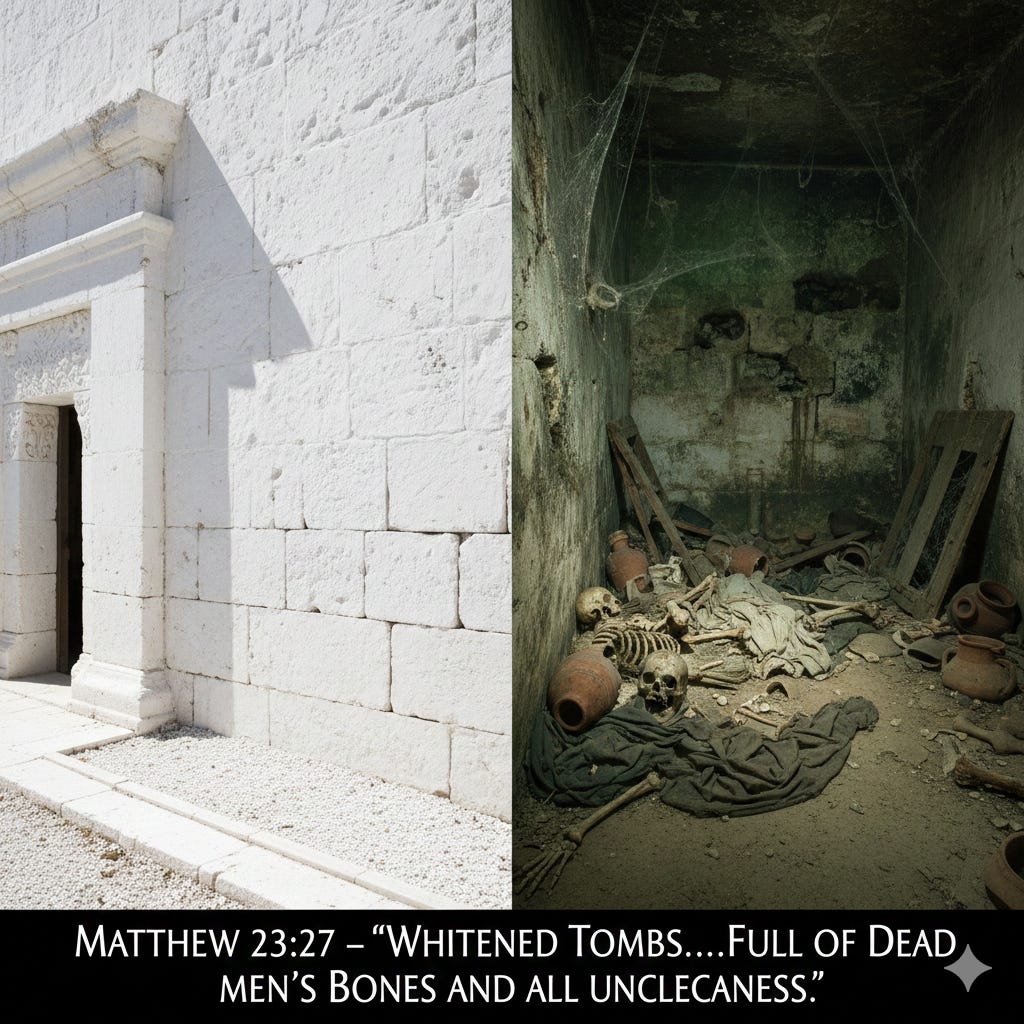
External polish, internal decay: “Whitewashed tombs.”
Self‑deception: Believing they would never repeat the sins of their fathers while actively doing so.
These themes are not bound to first‑century Judaism. They are the perennial temptations of any religious system that drifts from the living Christ.
The Laodicean Church: A Portrait of Comfortable Religion
Revelation 3 describes a church that is neither hot nor cold—neither openly rebellious nor passionately faithful. It is self‑assured, wealthy, and blind to its spiritual poverty.
Revelation 3:14-22 LSB “And to the angel of the church in Laodicea write: This is what the Amen, the faithful and true Witness, the Beginning of the creation of God, says: (15) ‘I know your deeds, that you are neither cold nor hot. I wish that you were cold or hot. (16) ‘So because you are lukewarm, and neither hot nor cold, I will spit you out of My mouth. (17) ‘Because you say, “I am rich, and have become wealthy, and have need of nothing,” and you do not know that you are wretched and pitiable and poor and blind and naked. (18) I advise you to buy from Me gold refined by fire so that you may become rich, and white garments so that you may clothe yourself, and that the shame of your nakedness will not be manifested; and eye salve to anoint your eyes so that you may see. (19) ‘Those whom I love, I reprove and discipline. Therefore be zealous and repent. (20) ‘Behold, I stand at the door and knock. If anyone hears My voice and opens the door, I will come in to him and will dine with him, and he with Me. (21) ‘He who overcomes, I will grant to him to sit down with Me on My throne, as I also overcame and sat down with My Father on His throne. (22) ‘He who has an ear, let him hear what the Spirit says to the churches.’”
Laodicea’s defining traits:
Self‑sufficiency: “I need nothing.”
Blindness to spiritual reality: “You do not realise that you are wretched, pitiable, poor, blind, and naked.”
Christ outside the door: Jesus is not at the centre; He is knocking from the outside.
A call to repent, not to reorganise: The issue is not structure, but heart.
The Laodicean church is the natural outcome of institutional religion that has lost its prophetic edge. It is the end stage of Matthew 23’s disease.
Why This Matters
The letter to the Laodicean Church of Revelation 3 is the seventh letter. Seven is Yahweh’s number of completion. Anything identified with a symbolic seven in prophecy (like Revelation) means it is the last. There will be no eighth church. The seven letters are the timeline of the Church Age. The timeline ceases with Laodicea.
The return of Jesus is next, not the mythical rapture and seven-year tribulation of unbelievers. If you do not see the urgency or feel it in my writings, may Yahweh have mercy on you.
Illegitimate Authority: When Institutions Claim What Belongs to Christ Alone
One of the most striking parallels between Matthew 23 and the modern church is the presumption of religious leaders to declare forgiveness of sins as if it were an institutional privilege rather than a covenantal reality rooted in repentance and faith.
How illegitimate authority manifests today:
Sacramentalism without discipleship: Offering absolution through rituals rather than transformation.
Clericalism: A professional class claiming spiritual powers unavailable to ordinary believers.
Institutional gatekeeping: Churches positioning themselves as the exclusive mediators of grace.
Transactional forgiveness: Confusing church membership, tithing, or participation with spiritual standing.
Doctrinal minimalism: Reducing the gospel to “God forgives you” without the call to die to self and follow Jesus.
This mirrors the Pharisees’ error: claiming spiritual authority while rejecting the very heart of God’s kingdom.
Jesus never entrusted institutions with the power to forgive sins. Only Jesus has that power.
Matthew 9:1-8 LSB And getting into a boat, Jesus crossed over the sea and came to His own city. (2) And behold, they brought to Him a paralytic lying on a bed. Seeing their faith, Jesus said to the paralytic, “Take courage, son; your sins are forgiven.” (3) And behold, some of the scribes said to themselves, “This man blasphemes.” (4) And Jesus knowing their thoughts said, “Why are you thinking evil in your hearts? (5) “For which is easier, to say, ‘Your sins are forgiven,’ or to say, ‘Get up and walk’? (6) “But so that you may know that the Son of Man has authority on earth to forgive sins”—then He said to the paralytic, “Get up, pick up your bed and go home.” (7) And he got up and went home. (8) But when the crowds saw this, they were afraid, and glorified God, who had given such authority to men.
The above passage emphasises that it is easy to say your sins are forgiven, but it is the authority that accompanies the words that matters. The Pharisees proclaimed illegitimate authority, as Matthew 23 forcefully asserts.
The Closed Door of the Kingdom
Jesus accused the Pharisees of shutting the kingdom in people’s faces. Today, the institutional church often does the same—not by strictness, but by lukewarmness.
Ways the modern church closes the door:
By preaching comfort instead of repentance
By offering belonging without transformation
By replacing discipleship with programs
By elevating leaders instead of equipping saints
By promising forgiveness without obedience
A church that refuses to call people to the humility of repentance cannot lead them into resurrection life. It becomes a spiritual hospice—comforting people on their way to destruction.
Whitewashed Tombs: The Illusion of Health
Many institutional churches appear vibrant—large buildings, polished services, charismatic leaders, impressive budgets. But Jesus’ words cut through the façade:
“You are like whitewashed tombs, which outwardly appear beautiful, but within are full of dead men’s bones.” Matthew 23:27
The Laodicean church is not dying; it is dead while claiming to be alive. It is spiritually hollow, even as it maintains the appearance of success.
Symptoms of whitewashed religion:
Branding without holiness
Community without covenant
Teaching without obedience
Worship without surrender
Forgiveness without repentance
This is not the church Jesus is building. It is the church He warns.
The True Ekklesia: A People, Not an Institution
Jesus did not come to establish a religious hierarchy. He came to form a people—a family, a body, a priesthood of believers.
The authority Jesus actually gives:
Authority to make disciples
Authority to bind and loose in alignment with heaven
Authority to proclaim the gospel
Authority to proclaim Yahweh’s forgiveness to the repentant
Authority rooted in obedience, humility, and the Spirit
This authority is relational, not positional. It flows from abiding in Christ, not from titles, degrees, or denominational structures.
When institutions claim authority apart from discipleship, they repeat the sins of Matthew 23.
The Call of Jesus: Come Out, Repent, and Follow Me
The message to Laodicea is not condemnation but invitation:
Buy gold refined by fire
Receive white garments
Anoint your eyes with salve
Be zealous and repent
Jesus stands at the door—not of the unbeliever, but of the church. He calls His people out of lukewarm religion and into a living, costly discipleship.
The woes of Matthew 23 and the warning to Laodicea converge into a single plea:
Return to Me. Leave behind the systems that obscure my voice. Follow Me in the narrow way of the cross.
Conclusion: A Prophetic Mirror for Our Time
Matthew 23 is not a relic. It is a prophetic mirror held up to every generation of God’s people. And today, it exposes a church culture that has become comfortable, self‑assured, and spiritually powerless—claiming authority it does not possess and offering forgiveness it cannot give.
But Jesus’ rebuke is always an invitation. The door is still open. The call is still clear.
Come out of lukewarm religion.
Come into the fire of true discipleship.
Come follow the One who alone has the authority to forgive sins.
Blessings
Geoff
To view the full article, participate in the discussions, and support other like-minded individuals, join the Jesus Plus ZERO End Times Community for FREE from this link.
I am a historicist when it comes to prophecy. The seven churches and the seven seals are the prophetic timeline of the Church Age. The only unfulfilled prophecy in Revelation is the second beast of Revelation 13 (apart from the return of Jesus), and that is forming as we speak.
A simple morning prayer of faith and song 2/3/26
“For I say to you, you shall see Me no more till you say, ‘Blessed is He who comes in the name of the LORD!” Matthew 23:39 NKJV
Oh, LORD in Heaven above, help us always to keep You as our first Love, doing all for Your honor and glory. Thank You, yes, and come quickly, LORD. Amen
GOD bless you all!
First Love - James Block
https://www.youtube.com/watch?v=pmqhw9BPeF4