



When we read the opening pages of Scripture, it is easy to view the creation narrative through a purely cosmic or chronological lens.
We marvel at the spoken light, the separation of the waters, and the sudden architecture of the universe laid out across the opening chapter of Genesis. However, as we turn the page to Genesis chapter 2, the narrative structure undergoes a dramatic shift.
To the casual reader or the modern critic, Genesis 2 can feel like an entirely different, even conflicting, creation story.
But this perspective misunderstands the brilliance of ancient Near Eastern literary design.
Genesis 2 is not a second timeline; it is a massive close-up. It is a deep-dive, microscopic recap of Day Six. While chapter 1 gives us the macro, sovereign view of the creation week, chapter 2 pauses the clock on the sixth day, zooms in on the geography of the Garden of Eden, and reveals the intimate, intricate details of how Yahweh formed humanity and established our spiritual reality.
By exploring this recap, we uncover the divine blueprint for human existence, revealing that our physical lives, our morality, our relationships, and our families were always intended to be the outward expression of a deeper spiritual reality.
The Geography of Spiritual Union: The Two Trees
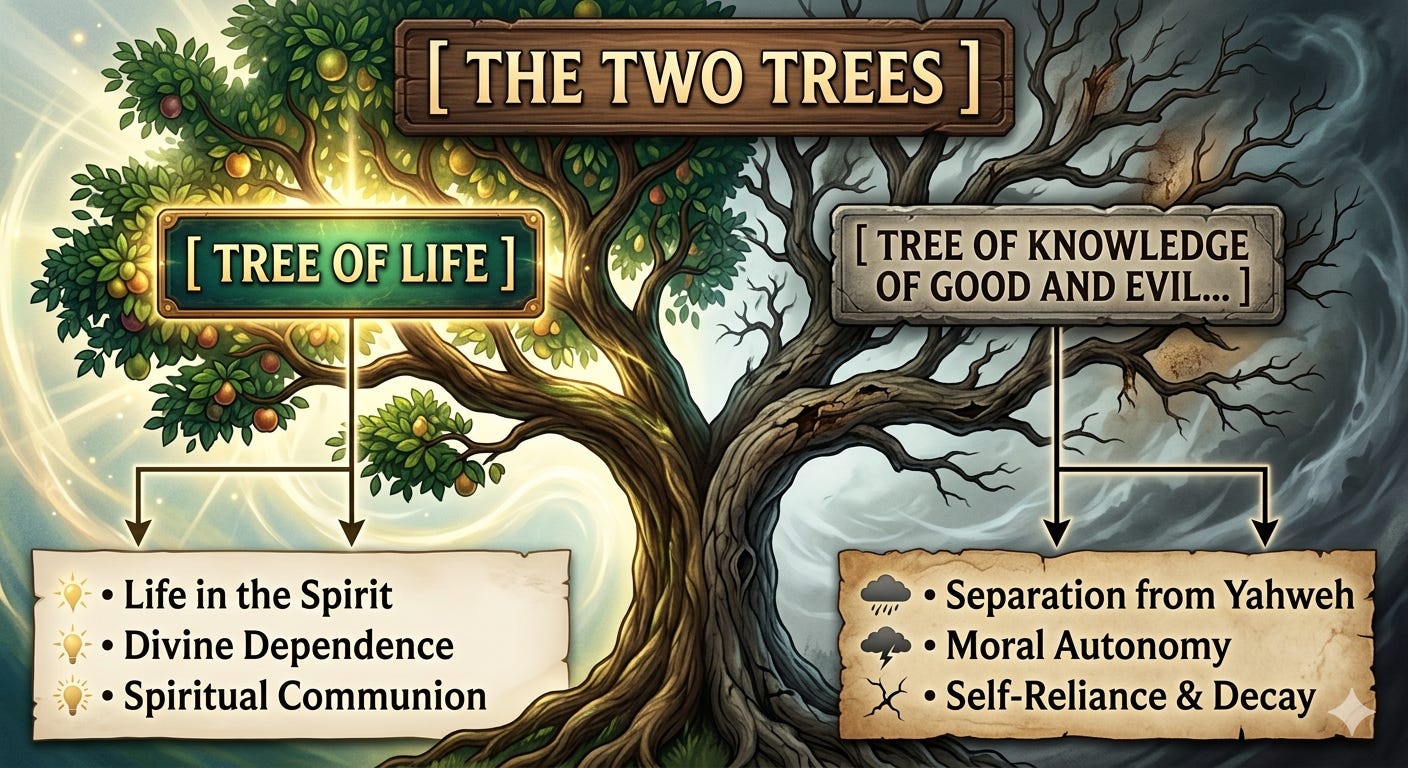
At the literal and theological centre of the Garden of Eden, Yahweh placed two distinct trees: the Tree of Life and the Tree of the Knowledge of Good and Evil. These were not mere decorative landscaping, nor were they arbitrary tests designed to trip humanity up. They represent profound spiritual typologies that define the only two paths a human soul can walk.
The Tree of Life: A Typology of Life in the Spirit
The Tree of Life is the ultimate physical manifestation of a spiritual union: a life lived entirely in and through the Spirit of God. To eat of this tree is to actively draw sustenance, vitality, and eternal continuity from the presence of Yahweh.
Human beings were not created to be self-sustaining entities. We were designed to be vessels that require a constant, unbroken flow of spiritual union. The Tree of Life represents a posture of absolute dependence and intimacy. In this state, man’s mind, emotions, and desires are perfectly nourished by the Holy Spirit. It is the archetype of the branch remaining securely attached to the vine, experiencing a perpetual stream of living water.
The Tree of the Knowledge of Good and Evil: A Typology of Separation
Conversely, the Tree of the Knowledge of Good and Evil stands as the typology of a life lived in separation from Yahweh. To understand this tree, we must look past modern definitions of “knowledge.” In the original context, the phrase “knowledge of good and evil” does not refer to intellectual data or an academic understanding of morality.
Rather, it signifies moral autonomy.
To take from this tree is to claim the right to determine for oneself what is good and what is evil, independent of the Creator. It is humanity declaring its independence from God, essentially saying, “I will be the captain of my own soul, the author of my own truth, and the judge of my own reality.” It is the very definition of spiritual self-reliance. When humanity chose this tree, they were not just breaking a rule; they were exchanging a life rooted in the Spirit for a life rooted in the fragile, finite self.
The Anatomy of the Fall: Spiritual Death Invoking Physical Death
This understanding of the two trees clarifies one of the most heavily debated passages in the book of Genesis. In Genesis 2:17, Yahweh gives Adam strict boundaries regarding the tree of autonomy:
Genesis 2:17 LSB but from the tree of the knowledge of good and evil, you shall not eat from it; for in the day that you eat from it you will surely die.”
When we read the subsequent narrative in Genesis 3, a historical and theological puzzle emerges. Adam and Eve take the fruit, they eat it, and yet they do not drop dead physically that very second.
In fact, the biblical record shows that Adam lived on for hundreds of years afterwards.
This leads to an important question: Did God’s warning fail to come to pass?
Or did the serpent speak the truth when he whispered, “You surely will not die”?
The answer is found in recognising that Yahweh was referring primarily to spiritual death.
The exact moment humanity chose autonomy over intimacy, their spirits were instantly severed from the life-giving Spirit of God. True life is not merely the pumping of a heart or the firing of synapses; true life is union with Yahweh.
Therefore, spiritual death is the state of being cut off from the Source of life.
Consider a branch that is suddenly snapped off from an apple tree. To the untrained eye, that branch might still look alive for a few days. The leaves are still green, and the bark still retains some moisture. But the branch is already dead. It has been disconnected from its source of nourishment. Its ultimate decay is now a mathematical certainty; it is only a matter of time.
This is precisely what occurred in the Garden.
The immediate spiritual death invoked the eventual physical death.
The moment Adam and Eve’s spiritual core was unanchored from the Tree of Life, their physical bodies entered a state of decay. Aging, sickness, and physical mortality were the natural, inevitable outworkings of an internal spiritual disconnection.
The physical death was simply the visible receipt of a spiritual transaction that had occurred the precise second they disobeyed.
The Divine Architecture of Marriage: A Union of Spirits
As Genesis 2 continues to zoom in on the details of Day Six, it transitions to the creation of the woman.
Yahweh observes the man and declares,
Genesis 2:18 LSB Then Yahweh God said, “It is not good for the man to be alone; I will make him a helper suitable for him.”
In modern vernacular, the word “helper” (Hebrew: Ezer) has unfortunately been diluted to imply a subordinate assistant or a secondary companion.
However, in the Old Testament, Ezer is a term frequently used to describe God Himself as Israel’s helper in times of desperate need. It denotes a position of strength, an indispensable counterpart.
When we view the creation of Eve through the broader spiritual landscape of Genesis 2, we see that her creation was not merely about solving Adam’s loneliness or providing him with an assistant.
It was about establishing the divine ecosystem for human covenant, unity, and family.
Before the Fall, Adam and Eve operated in perfect spiritual alignment.
When God caused a deep sleep to fall upon Adam and fashioned a woman from his rib, He did not just create a second biological specimen; He created a spiritual equal.
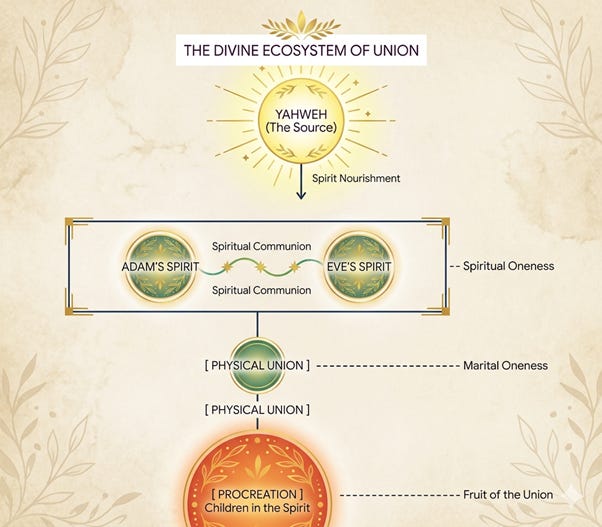
Their union was first and foremost a union of their spirits, both fully alive, operating in tandem, and nourished by the Tree of Life. They were two spirits anchored in the Holy Spirit, looking together toward their Creator.
This profound spiritual union provided the necessary framework and foundation for their physical oneness. Because their spirits were knit together in the divine life of Yahweh, their physical relationship was completely pure, holy, unhindered, and free from shame.
It was out of this exact spiritual ecosystem that the procreation of children was designed to occur. Humanity was intended to multiply and fill the earth through families where the parents’ spirits were actively united in Yahweh.
Children were meant to be born into a world where they would inherit an unbroken legacy of life in the Spirit. The physical act of procreation was never meant to be a detached biological event; it was designed to be the physical overflow of a profound, spirit-to-spirit covenant.
Returning to the Garden: The Gospel Connection
When we understand that Genesis 2 is a detailed blueprint of the human soul, the entire arc of the biblical narrative becomes vividly clear.
The Old and New Testaments are not a collection of disconnected moral stories; they are the chronicle of God restoring humanity back to the spiritual reality outlined on Day Six.
When mankind chose the tree of autonomy, we inherited an ecosystem of spiritual death, which manifested in broken relationships, fractured marriages, physical decay, and ultimate separation from God. We became a race of disconnected branches, attempting to find life in our own strength while slowly withering away.
But the good news of the Gospel is that Jesus Christ came as the Second Adam to reverse the curse of the first. He did not come merely to give us a set of rules to make our autonomous lives look better. He came to crush the power of spiritual death and reinstate spiritual union.
When Jesus hung upon a tree at Calvary, He absorbed the full weight of our spiritual separation so that the path back to the Creator could be permanently restored. Through His resurrection, the way to the Tree of Life has been thrown wide open once again.
When we place our faith in Christ, we are not just adopting a religion; we are being grafted back into the Vine.
We are stepping out of the spiritual death invoked by the tree of autonomy and stepping back into the life of the Spirit. Our marriages, our families, and our individual identities are meant to be reordered according to the Genesis 2 blueprint, where everything physical, tangible, and visible in our lives flows beautifully from an intimate, unbroken union with Yahweh.
My Jesus-given purpose is to support the remnant. For a full explanation of this purpose, click this link.


