



Introduction: The Hermeneutical Inversion and Modern Lukewarmness
The contemporary church landscape is plagued by a subtle yet devastating theological malaise: a pervasive spiritual lukewarmness.
While this condition is frequently diagnosed through the lens of sociological shifts, moral relativism, or cultural compromise, its true root is structural and interpretive.
It is a failure of hermeneutics (the science of textual interpretation).
Specifically, the modern church has often read the New Testament through the Old, rather than interpreting the Old Covenant in light of the explicit and final reality of the New.
When the text is inverted this way, the entire redemptive narrative is turned upside down. The temporary is mistaken for the eternal; the shadow is worshipped in place of the substance; and the interim vehicle is elevated above the ultimate destination.
Whenever the people of God mistake the scaffolding for the completed temple, the enemy gets a strategic foothold.
Satan does not always attack the church with overt heresy; more frequently, he seduces her into a regressive fixation on outdated shadows, legalistic frameworks, and nationalistic pride. By keeping the believer’s eyes glued to the structural arrangements of the Old Covenant, the adversary effectively insulates them from the disruptive, global, and transformative power of the New Covenant in Jesus Christ.
Nowhere is this interpretive battleground more visible, yet more consistently overlooked, than in Genesis 10.
Commonly referred to by biblical scholars as the Table of Nations, Genesis 10 is often treated by casual readers as a dry, genealogical wasteland, a static list of names to be rapidly skimmed on the way to the narrative action of the Tower of Babel in chapter 11.
Yet, when examined through a robustly Christocentric lens, Genesis 10 emerges as the indispensable geopolitical and theological blueprint for the entire canon of Scripture.
It outlines the scope of global brokenness, introduces the cosmic conflict between humanistic pride and divine promise, and establishes the strict boundaries of God’s interim strategy: the selection of a single bloodline to serve as the womb for the cosmic Deliverer.
To analyse Genesis 10 correctly is to dismantle the foundations of modern religious lukewarmness, slamming the door on the enemy’s deceptions and restoring Jesus Christ to His rightful place as the absolute alpha and omega of human history.
1. The Architecture of the Table: The Sovereignty of Seventy
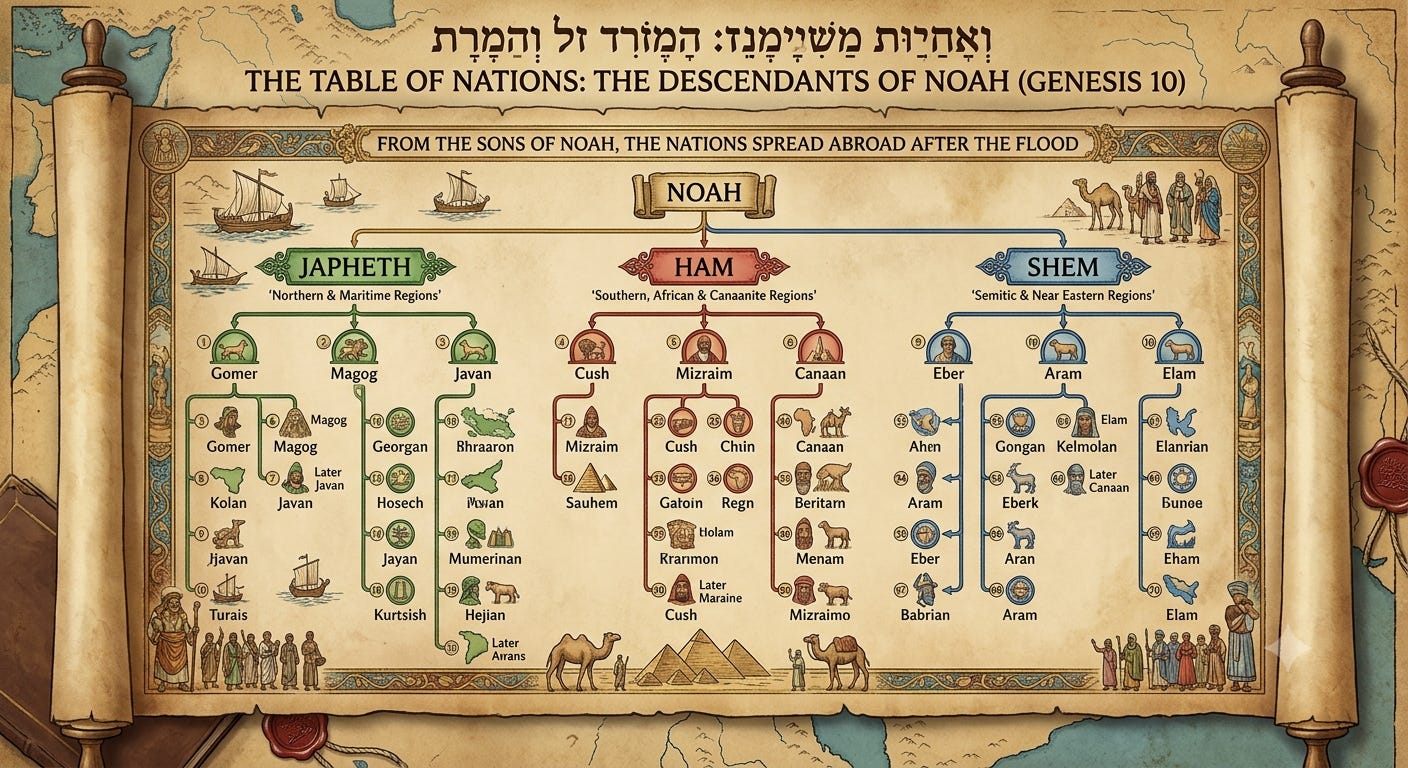
Genesis 10 provides a macro-historical survey of the post-diluvian world, charting the expansion of humanity through the three sons of Noah: Shem, Ham, and Japheth.
The chapter concludes with a structural summary statement:
Genesis 10:32 LSB These are the families of the sons of Noah, according to their generations, by their nations; and out of these the nations were separated on the earth after the flood.
When counting the specific individuals and people groups enumerated in this chapter, the total arrives at exactly seventy names. In the symbolic vocabulary of Semitic literature, seventy is not an arbitrary statistic; it is the number of organisational completeness, representing the totality of global humanity.
The Tripartite Dispersion
The text carefully distributes these seventy nations into three distinct geographical and cultural streams, each carrying profound long-term implications for the biblical narrative:
The Japhetic Nations (Gen 10:2-5): Occupying the maritime regions, the coastlands, and the northern territories (modern Europe and Asia Minor). They are described as spreading out into their lands, “each with his own language, by their clans, in their nations” (Gen 10:5).
The Hamitic Nations (Gen 10:6-20): Occupying the southern and southwestern zones, including North Africa, Egypt (Mizraim), Cush, and critically, the land of Canaan. This line becomes the primary incubator for the historical adversaries of God’s covenant people.
The Semitic Nations (Gen 10:21-31): Occupying the central Near Eastern regions. This is the line of Shem, designated by the text as the ancestor of all the children of Eber, from whom the term Hebrew originates.
The Lukewarm Misconception vs. The Mission Matrix
The foundational error of modern lukewarm theology is the assumption that God’s selection of the Semitic line implies an ultimate abandonment or ontological rejection of the other sixty-nine nations.
Legalistic and tribalistic interpretations view Genesis 10 as the moment God “gave up” on the world at large to focus exclusively on a single ethnic favorite.
This view directly fosters a passive, insular faith that separates holiness from global mission.
However, when viewed through the corrective lens of the New Covenant, Genesis 10 reveals itself not as an exclusion matrix but as a mission matrix.
The seventy nations are catalogued precisely because they constitute the ultimate scope of the redemptive plan. God does not narrow His focus to the line of Shem out of arbitrary favouritism; He narrows His focus tactically to create a pure, preserved bloodline capable of bearing the incarnation of God. The reduction of the narrative focus to one family is a temporary, strategic retreat in order to launch a universal offensive.
This structural reality is dramatically vindicated in the New Testament.
In Luke 10, when Jesus commissions a vanguard of disciples to declare that the Kingdom of God has arrived in proximity to the human experience, the text specifies that He sends out exactly seventy (or seventy-two, depending on textual variants matching the Septuagint translation of Genesis 10).
This is an explicit, prophetic echo.
By sending seventy couriers into the highways and byways, Jesus was structurally declaring that Israel’s interim isolation was drawing to a close.
The Messiah was claiming ownership over every single square inch of the global topography mapped out in Genesis 10. The Gospel was never designed to be an extension of regional Jewish identity; rather, Israel was the historical runway from which the rocket of global redemption was launched.
2. The Great Interruption: Nimrod and the Anatomy of Imperial Pride
The rhythmic, repetitive cadence of Genesis 10, in the predictable, steady march of generations, is suddenly and violently interrupted in verse 8.
The text undergoes a sharp literary shift, zooming in with microscopic intensity on a single individual from the line of Ham:
Genesis 10:8-10 LSB Now Cush was the father of Nimrod; he began to be a mighty one on the earth. (9) He was a mighty hunter before Yahweh; therefore it is said, “Like Nimrod a mighty hunter before Yahweh.” (10) The beginning of his kingdom was Babel and Erech and Accad and Calneh, in the land of Shinar.
The Linguistic Camouflage of the Rebel
In conventional, Westernised readings of Scripture, the description of Nimrod as a “mighty hunter before the Lord” has been erroneously sentimentalised. He is frequently mischaracterised as a rugged, commendable frontiersman who operated under divine favour.
This is a severe misreading that completely obscures the passage’s dark spiritual undercurrents.
In the Hebrew text, the phrase “before the Lord” (liphnei YHWH) carries a distinct confrontational edge. It translates more accurately as “in the face of Yahweh” or “in open defiance to the Lord.”
The name Nimrod itself is derived from the Hebrew root marad, which literally means “we will rebel.”
Nimrod was a hunter of human souls, a tyrant who weaponised charisma, physical prowess, and military innovation to subjugate his fellow men.
He was the first human being in the post-flood epoch to cross the threshold into centralised, autocratic tyranny, asserting himself as a “mighty one” (gibbor), a word heavily tied to the rebellious, pre-flood Nephilim era of Genesis 6.
The Foot in the Door: How Satan Capitalises on Pride
Nimrod represents the precise historical moment where Satan successfully secured a systemic foothold in the reconstructed world.
God’s primordial mandate to Noah and his progeny was clear, unyielding, and decentralised.
The divine design favoured a widespread, agrarian, decentralised distribution of humanity, with families and clans governing themselves under the direct, unmediated sovereignty of Yahweh.
Nimrod recognised that a scattered humanity is difficult to control. Driven by a satanically inspired ambition for self-deification and total autonomy, he introduced a competing philosophy: urban centralisation and imperial consolidation.
Nimrod pulled humanity backward into dense, urban conglomerates. He constructed fortifications, raised standing armies, and established the world’s first network of major metropolitan empires: Babel, Erech, Akkad, and Calneh.
By doing so, he built a closed loop of human self-sufficiency.
This is the timeless blueprint of the flesh: building a system where human security is guaranteed by brick walls, human economic prosperity is managed by centralised systems, and human identity is anchored in a collective, corporate ego rather than dependence on the Creator.
Nimrod’s kingdom was an explicit effort to insulate humanity from the necessity of faith. It was a declaration that man could survive, thrive, and project power without any reference to the throne of God.
The Modern Parallels to the Nimrod Mindset
This ancient anatomy of pride is the exact genetic material of modern spiritual lukewarmness.
When the contemporary church shifts its reliance away from the raw power of the Holy Spirit and begins to mimic the organisational strategies of corporate empires, it is operating in the spirit of Nimrod.
Whenever a ministry values metrics over maturity, centralised control over organic discipleship, and the construction of massive, self-serving ecclesiastical platforms over the quiet, costly advancement of the Kingdom, it has built a modern Babel.
Satan does not need to introduce explicit atheism into a church to destroy it; he simply needs to persuade believers to rely on their own “mighty” capabilities, their own financial security, and their own strategic genius.
The moment we begin to build for our own names, we have slipped into the Hamitic current of defiance, effectively locking Christ out of the building.
3. The Line of Chesed: Preserving the Seed Amidst the Chaos
In stark, brilliant contrast to the loud, aggressive imperial expansions of the line of Ham, Genesis 10 quietly tracks an alternative lineage.
Tucked away in the latter half of the chapter is the record of the sons of Shem (Gen 10:21-31).
While Nimrod is busy erecting towers and branding his name across the plains of Shinar, the Semitic line is characterised by an absence of imperial fanfare.
Yet, it is within this quiet, unassuming line that the Chesed of God is actively at work.
Understanding Chesed
The Hebrew word Chesed defies simple one-word English translations. It is frequently rendered as “loving-kindness,” “mercy,” or “steadfast love.”
However, in its foundational theological context, Chesed refers specifically to covenant loyalty mixed with unmerited grace. It is the fierce, unshakeable commitment of God to fulfil His promises, regardless of the failure, chaos, or rebellion of the human partner.
In Genesis 10, Chesed is displayed through the preservation of the seed line. God watches humanity willingly surrender to the spell of Nimrod’s charisma. He sees the nations gravitating toward the unified rebellion that will soon culminate at Babel.
Yet, beneath the surface of global defection, God’s covenant loyalty is meticulously keeping a single line pure.
The text highlights a descendant named Eber (Gen 10:21, 24). Eber’s name means “the one who crosses over” or “the outsider.” From Eber comes the line of the Hebrews, a people destined by God to remain distinct, separated, and systematically isolated from the imperial matrix of the surrounding world.
The Selection of the Womb
The line of Shem moves inexorably toward Terah, and ultimately, toward Abram. This tracing is the structural setup for the Great Narrowing of the biblical narrative.
In Genesis 12, God will tell Abram to leave his country, his kindred, and his father’s house, to exit the entire urban, imperial legacy of Mesopotamian civilisation, and walk into an undefined wilderness.
The crucial point that modern readers must grasp is that this selection of Abraham’s line was an interim strategy, not an ultimate end.
God did not build the Hebrew nation because Israel was inherently superior to the other seventy nations. Rather, Israel was selected as the sacred repository of the law and the prophets, and ultimately as the biological womb for the incarnation.
To use a medical analogy: when a doctor prepares a lifesaving serum, they use sterile, highly controlled laboratory vessels to isolate the active elements. The vessel is absolutely essential, but its value derives entirely from the medicine it holds.
The lukewarmness of Israel in the Old Testament lies in confusing the container with the content. Israel was the vessel; Jesus Christ is the medicine.
4. The Inversion of Reality: The Old Testament Shadow and the New Testament Substance
The core spiritual problem of the contemporary church is its persistent tendency to evaluate the New Testament through an Old Testament paradigm.
This hermeneutical inversion manifests as an obsessive fascination with geopolitical Israel, an unhealthy infatuation with Old Covenant ritualism, and a functional return to a performance-based legalism.
This is precisely how the historical narrative is turned upside down, and it is the exact error that the writer of the Epistle to the Hebrews sought to systematically dismantle.
The Shadow and the True Form
Hebrews 10:1 establishes an unyielding interpretive axiom for all of Scripture.
Hebrews 10:1 LSB For the Law, since it has only a shadow of the good things to come and not the very form of things, can never, by the same sacrifices which they offer continually year by year, make perfect those who draw near.
A shadow possesses no independent life; it has no mass, no breath, and no intrinsic value.
It exists solely as a legal witness to the fact that a solid substance is standing nearby, casting it.
When a person walks in the blinding sun toward a loved one, they do not throw themselves onto the ground to kiss the shadow.
They pass through the shadow to embrace the living person.
Yet, when modern theology over-emphasises the interim national promises of the Old Covenant at the expense of the finished, cosmic work of Jesus Christ, it is doing exactly that: abandoning the Living Lord to embrace a historical shadow.
Old Testament Shadow (The Interim) - The Earthly Tabernacle / Temple
New Testament Substance (The Final) - The Living Body of Jesus Christ & The Church
Old Testament Shadow (The Interim) - The Levitical Priesthood
New Testament Substance (The Final) - The Eternal High Priesthood of Melchizedek (Christ)
Old Testament Shadow (The Interim) - The Geopolitical Nation of Israel
New Testament Substance (The Final) - The Trans-National, Global Body of Christ
Old Testament Shadow (The Interim) - The Physical Circumcision of the Flesh
New Testament Substance (The Final) - The Spiritual Circumcision of the Heart by the Spirit
Old Testament Shadow (The Interim) - The Animal Sacrifices
New Testament Substance (The Final) - The Once-for-All Substitutionary Atonement of the Cross
The Warning of John the Baptist and Jesus
This dangerous tendency to rely on the interim rather than the final was the exact fortress of pride that the religious leaders of the first century occupied.
They believed their eternal security was guaranteed by their physical lineage from Shem and Abraham. They mistook the interim vehicle for the final destination.
John the Baptist attacked this delusion with savage rhetorical force on the banks of the Jordan:
Matthew 3:9 LSB and do not suppose that you can say to yourselves, ‘We have Abraham for our father’; for I say to you that from these stones God is able to raise up children to Abraham.
John the Baptist was warning them that the historical utility of ethnic lineage was coming to a definitive end. The womb had finished its term; the Child had arrived. To cling to the womb once the Child is born is a medical catastrophe and a spiritual death sentence.
Jesus drove this point home in His famous conflict with the Pharisees in John 8. They argued, “Abraham is our father” (John 8:39). Jesus responded with a devastating distinction between biological descent and spiritual reality:
John 8:39-44 LSB They answered and said to Him, “Abraham is our father.” Jesus *said to them, “If you are Abraham’s children, you would do the deeds of Abraham. (40) “But now you are seeking to kill Me, a man who has told you the truth, which I heard from God. This Abraham did not do. (41) “You are doing the deeds of your father.” They said to Him, “We were not born of sexual immorality; we have one Father: God.” (42) Jesus said to them, “If God were your Father, you would love Me, for I proceeded forth and have come from God, for I have not even come of Myself, but He sent Me. (43) “Why do you not understand what I am saying? It is because you cannot hear My word. (44) “You are of your father the devil, and you want to do the desires of your father. He was a murderer from the beginning, and does not stand in the truth because there is no truth in him. Whenever he speaks a lie, he speaks from his own nature, for he is a liar and the father of lies.
Here, Christ completely detaches covenant identity from mere genetics, geography, or national heritage. True connection to God’s promise is exclusively defined by faith in Jesus Christ.
Anyone who stalls out in the Old Testament framework, believing that physical bloodlines, national borders, or external keeping of laws can grant special spiritual standing, has missed the entire trajectory of Scripture.
They have allowed Satan to use the Old Covenant itself as a roadblock to prevent them from entering the fullness of the New.
5. Theological Commentary: The Antidote to Modern Lukewarmness
How does this understanding of Genesis 10 serve as the definitive cure for the lukewarmness paralysing the modern church?
It does so by forcibly recentering the believer’s gaze on the absolute supremacy, finality, and sufficiency of Jesus Christ.
Dismantling the Performance Trap
Lukewarmness is almost always the inevitable byproduct of exhaustion.
It occurs when believers try to sustain a relationship with God by relying on the energy of the flesh, operating under an Old Covenant mindset of performance, rules, and external conformity.
They are living in the shadow world, constantly striving to measure up to a standard of righteousness that can only be found through resting in the finished work of Christ.
When we understand that the entire apparatus of the Old Testament, from the genealogies of Genesis 10 to the tribal divisions, the tabernacle dimensions, and the sacrificial protocols, was merely a temporary setup for the cross, we are instantly liberated from the performance trap.
We realise that our standing before God is not maintained by our strategic efforts, our political alignments, or our legalistic rigour.
It is anchored in the absolute perfection of Jesus, who stepped into the fractured geography of our world to do what we could never do for ourselves.
Restoring Cosmic Mission Over Tribal Insularity
Furthermore, a correct reading of Genesis 10 explodes the small-minded, tribal isolationism that characterises lukewarm churches.
When a church forgets that the seventy nations have always been the ultimate destination of the gospel, it settles into a comfortable, self-satisfied country-club mentality. It focuses inward, prioritising its own survival, comfort, and cultural preferences over the aggressive, sacrificial pursuit of the lost.
Genesis 10 reminds us that God has an unyielding, cosmic claim on every square inch of this planet. He sees the nations not as a secular threat to be feared or avoided, but as His rightful property, stolen by the enemy, that must be aggressively reclaimed through the preaching of the Cross.
A church that captures this vision cannot remain lukewarm.
It is instantly propelled out of its apathy and into the global harvest field, driven by the realisation that Jesus did not die to save a localised enclave, but to purchase for Himself a bride from every tongue, tribe, people, and nation.
Conclusion: Preparing the Lens for Genesis 11
Genesis 10 leaves us standing on a razor’s edge.
The global map has been drawn; the seventy nations have been established in their respective territories.
The line of Chesed has been quietly preserved through the sons of Shem, even as the dark shadow of imperial pride has begun to project itself over humanity through the tyrannical leadership of Nimrod.
The stage is now set for the great confrontation of Genesis 11.
We have been introduced to the characters and the competing philosophies; next, we will witness the inevitable collision between man’s pride and God’s sovereignty on the plains of Shinar.
As we prepare to analyse the crisis at the Tower of Babel, let us resolve to cast off the lukewarm hermeneutic that clings to historical shadows and tribal illusions.
Let us look at this ancient text with clear eyes, recognising that from the very first pages of Genesis, God’s eyes have been fixed on the global horizon, and His heart has been set on the ultimate, unshakeable victory of His Son, Jesus Christ.
Jesus is begging YOU to get out of the stands and onto the field. He is not a spectator sport. Repent and believe. It is your only hope.
Many blessings
Geoff
My Jesus-given purpose is to support the remnant. For a full explanation of this purpose, click this link.


