



Introduction: The Hermeneutical Horizon of Genesis 1–11
The opening eleven chapters of the Book of Genesis constitute the structural and theological bedrock of the entire biblical canon.
Often classified by commentators as the “Primeval History,” this foundational section does not merely provide an introductory backdrop to the patriarchal narratives that begin with Abraham in chapter 12.
Rather, it serves as a self-contained, macro-historical overture that defines the cosmic boundaries of space, time, human nature, divine judgment, and covenant architecture.
Within this primeval framework, Genesis 11 serves as both a climax and a pivot. Structurally, it is the finale of the ancient world. The chapter is explicitly divided into two major movements that mirror this dual identity:
1. Verses 1–9 provide the granular, historical explanation behind the ethnographic and linguistic scattering briefly summarised in the “Table of Nations” in Genesis 10:5.
2. Verses 10–26 transition the literary lens from global, cosmic sweeps down to a highly specific, mathematically sealed chrono genealogy tracking the line of Shem.
For the contemporary believer, navigating Genesis 11 requires a rigorous commitment to historical-grammatical hermeneutics—an interpretive framework that prioritises the author’s original intent, the text’s strict grammatical construction, and the historical-covenantal context of the recipients.
When approached through this disciplined lens, Genesis 11 emerges as a fierce apologetic for the structural, historical, and chronological integrity of the early earth, while simultaneously laying the indispensable typological groundwork for the New Testament.
Specifically, the chapter presents two primary pillars of truth that shatter modern, compromised interpretations:
First, the precise, gapless timeline embedded within the lineage of Shem provides a concrete chronological marker that defends the historical reality of a young earth.
Second, the linguistic judgment enacted at the Tower of Babel establishes a profound covenantal crisis that finds its exact structural reversal not in modern ecstatic experiences but in the miraculous gathering of the scattered Hebrew Diaspora on the Day of Pentecost in Acts 2.
By restoring these twin pillars to their proper exegetical foundations, the church today can insulate itself against both the chronological compromises of old-earth uniformitarianism and the faulty hermeneutics of modern experiential movements.
Part I: The Chrono Genealogies of Shem and the Young Earth Reality
The Grammatical Architecture of Chrono Genealogies
To appreciate the apologetic weight of Genesis 11:10–26, one must first recognise its unique literary genre.
The text does not present a standard ancient Near Eastern genealogy, which frequently utilised fluid generation tracking to establish broad tribal lineages or social prestige.
Instead, biblical scholars classify this specific format as a chrono-genealogy, a highly structured, mathematically precise record designed to calculate time across generations.
The text's internal grammar employs a repetitive, rigid formula that effectively eliminates the possibility of chronological gaps or missing generations. The text repeats the following syntactical pattern with rhythmic consistency:
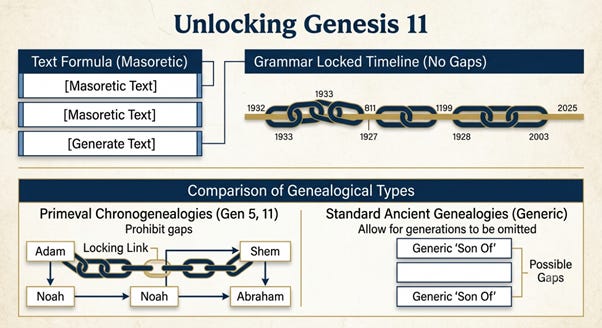
This grammatical structure locks the chronological timeline into a continuous, interlinked chain.
Even if one were to argue, from external cultural contexts, that the word “fathered” (yalad) could occasionally imply a grandfather-grandson relationship, the inclusion of the exact age of the father at the time of birth renders any hypothetical generational gap chronologically irrelevant.
If Person A is thirty-five years old when his descendant is brought forth, the absolute time elapsed between the two individuals is fixed at exactly thirty-five years, regardless of whether Person B is an immediate son or a more distant heir.
Consequently, by linking the chrono genealogy of Genesis 5 (which calculates the exact duration from the creation of Adam to the Flood of Noah) directly to the chrono genealogy of Genesis 11 (which calculates the duration from the Flood to the birth of Abram), the text constructs an unbroken, mathematically sealed historical timeline.
When these numbers are compiled using the Hebrew Masoretic text, the span from the creation of the universe to the arrival of Abraham is constrained to approximately two millennia.
This leaves no room for the insertion of vast, multi-million-year epochs of evolutionary development or hominid prehistory without doing violence to the plain, structural mechanics of the Hebrew prose.
The Biological Decay Curve of the Post-Flood Era
Beyond its mathematical continuity, the lineage of Shem provides compelling internal evidence of historical realism through the recorded lifespans of the patriarchs.
A statistical analysis of the post-Flood lifespans reveals a highly specific, systematic downward trajectory rather than a chaotic or arbitrary assignment of numbers.
When plotted visually, these lifespans do not represent the erratic ups and downs characteristic of legendary folklore. Instead, they trace a mathematically consistent biological decay curve.
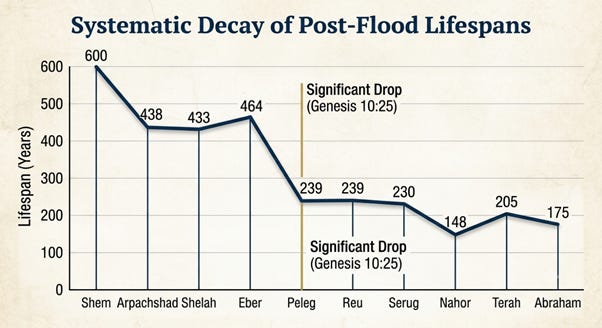
From a Young Earth Creationist perspective, this systematic tapering reflects a genuine biological and ecological reality.
The global Deluge of Genesis 6–9 was a cataclysmic tectonic event that fundamentally altered Earth’s atmosphere, radiation shielding, dietary profiles, and environmental stability.
Simultaneously, the survival of human life through a single family unit (Noah and his sons) created an intense genetic bottleneck.
The rapid drop in longevity, particularly the sharp halving of lifespans at the birth of Peleg, is precisely what modern population geneticists would expect to observe when a small, isolated population undergoes rapid genetic drift and environmental stressors following a massive population crash.
The presence of this consistent biological curve within Genesis 11 serves as an internal fingerprint of historical authenticity. A late-date fabricator or an ancient mythmaker inventing a fictional pedigree would possess neither the statistical sophistication nor the genetic awareness required to construct such a precise, internally coherent curve of decay.
Biblical Historiography vs. Ancient Near Eastern Mythology
To fully appreciate the sober, historical nature of Genesis 11, it must be contrasted with the contemporary historiography of the ancient Near East.
Sceptics frequently attempt to relegate the primeval history of Israel to the realm of recycled Mesopotamian myth, arguing that Hebrew scribes merely adapted local legends during the Babylonian exile. However, a direct comparative analysis reveals an irreconcilable chasm between the two worldviews.
The most prominent secular parallel to the biblical genealogies is the famous Sumerian King List, preserved on various cuneiform prisms such as the Weld-Blundell weld prism. The Sumerian King List documents the reigns of political rulers in Mesopotamia, explicitly dividing them into two distinct eras separated by a great flood.
Consider the staggering numbers recorded within the pre-dynastic section of the Sumerian text:
“After the kingship descended from heaven, the kingship was in Eridug. In Eridug, Alulim became king; he ruled for 28,800 years. Alalngar ruled for 36,000 years. Two kings; they ruled for 64,800 years...”
Following the flood event, the Sumerian list records that lifespans dropped, yet they remained absurdly inflated, with kings like Jushur of Kish reigning for 1,200 years.
The differences between the Sumerian King List and Genesis 11 are structural, theological, and chronological:
Purpose: The Sumerian King List is a political document designed to legitimise a highly centralised, monarchical system by inflating the reigns of political emperors to status-altering lengths, transforming human kings into semi-divine figures. Genesis 11, conversely, is a domestic family registry. It does not track kings, pharaohs, or military conquerors; it tracks ordinary fathers, sheepherders, and nomads.
Numerical Style: The numbers in the Sumerian list are highly stylised, rounded figures based on the sexagesimal (base-60) numerical system popular in Babylonian mathematics (8 X 3600 = 28,800). They represent symbolic political units rather than literal durations of time. Genesis 11 features un-rounded, irregular numbers (such as Nahor fathering Terah at twenty-nine and living another 119 years).
The author of Genesis is intentionally rejecting the surrounding mythological frameworks.
By presenting specific ages, un-stylised numbers, and an unbroken lineage of ordinary human beings, Genesis 11 insists that the history of redemption is rooted in literal space-time reality. It presents a world that is young, dynamic, and meticulously tracked by its Creator.
Part II: The Structural Geography of Babel
The Rebellion of Centralisation
Before examining the reversal of the Babel judgment in the New Testament, we must thoroughly map the judgment's geographic and corporate parameters.
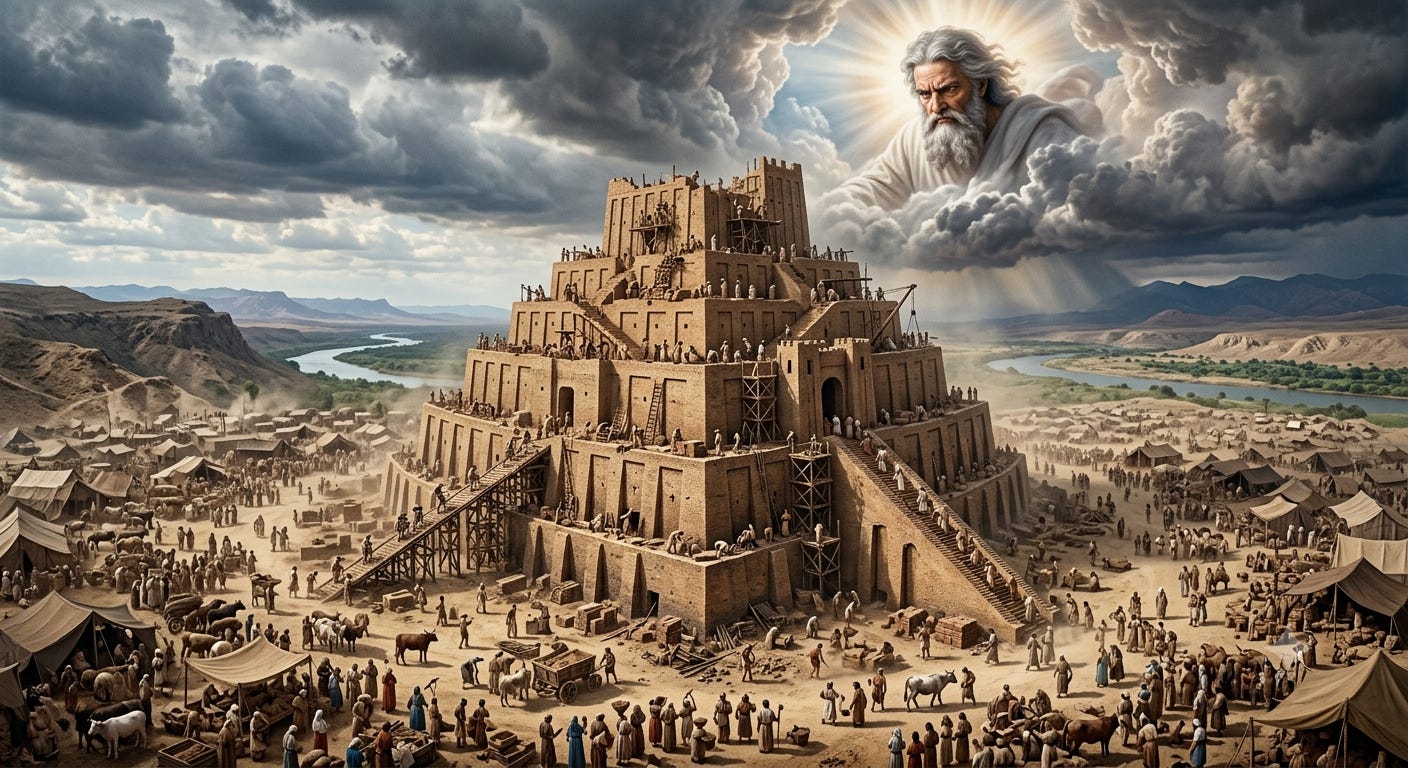
Genesis 11:1 establishes that “the whole earth had one language and the same words.” As humanity migrated from the east, they discovered a plain in the land of Shinar—modern-day southern Iraq/Babylonia—and settled there.
This settling was an explicit act of corporate mutiny against God’s creation mandates. Following both the Creation and the Flood, God issued an identical, non-negotiable imperative to humanity: “Be fruitful and multiply and fill the earth” (Genesis 1:28, Genesis 9:1).
God’s design for humanity was geographical distribution, cultural diversification, and the expansion of His image across the entire face of the globe.
Humanity’s response at Shinar was an aggressive counterstrategy of urbanisation and centralisation:
Genesis 11:4 LSB And they said, “Come, let us build for ourselves a city, and a tower whose top will reach into heaven, and let us make for ourselves a name, lest we be scattered over the face of the whole earth.”
God’s Mandate: The core of the Babel sin was not merely architectural ambition; it was a socio-political rebellion against God’s sovereign boundaries.
The tower (likely a ziggurat, a monumental, tiered temple-platform common in ancient Mesopotamia) was intended to serve as the religious and political anchor of a self-deifying, global human empire.
By creating a centralised sanctuary and a unified, autonomous collective, humanity sought to secure its own security, survival, and fame independent of Yahweh's covenant lordship.
The Judgment of Language Barriers
The divine response to this centralised rebellion is marked by deep irony.
The text notes that Yahweh “came down” to see the city and the tower which the children of man had built. The towering achievement of human engineering was so microscopic from heaven's perspective that God had to descend just to inspect it.
God recognises that the primary engine driving this corporate rebellion is their linguistic and political uniformity:
Genesis 11:6 LSB And Yahweh said, “Behold, they are one people, and they all have the same language. And this is what they have begun to do. So now nothing which they purpose to do will be impossible for them.
Left unchecked, this global totalitarian system would completely stifle the execution of the creation mandate and accelerate human depravity to pre-Flood levels.
Therefore, God executes a surgical, localised judgment:
Divine Council Decree - “Come, let us go down and there confuse their language…”
Sociological Outcome - Disrupts cognitive empathy and ends structural cooperation.
By scrambling their shared vocabulary, God fractures their capacity for collaborative execution.
The confusion of tongues immediately forced humanity into localised, tribal clusters based on linguistic compatibility.
The dream of a global empire collapsed under the weight of sudden communication barriers. The city was abandoned, and humanity was forcefully scattered across the face of the earth.
This moment marks the formal origin of distinct ethno-linguistic identities. Importantly, it is a judgment of division.
The nations, divided by language and geography, were abandoned to their own devices, left to wander in spiritual blindness under the boundaries of the Babel curse.
Part III: The Typological Architecture of Pentecost
The Redemptive Context of Acts 2
To read the New Testament with a mature hermeneutic is to recognise that the Holy Spirit does not work in a historical vacuum.
The events of the New Testament are deliberately calibrated to act as the legal fulfilment, thematic reversal, or covenantal climax of the patterns established in the Old Testament.
This structural interplay is explicitly visible in the relationship between Genesis 11 and Acts 2.
The Day of Pentecost is often celebrated as the birthday of the Christian church, but its significance is deeply missed when extracted from its Old Testament covenantal framework.
Pentecost (known in the Hebrew calendar as Shavuot, or the Feast of Weeks) was one of the three mandatory pilgrimage feasts prescribed in the Mosaic Law (Exodus 23:14–17). It took place exactly fifty days after the Passover Sabbath, marking the celebration of the first fruits of the wheat harvest and, historically within Jewish tradition, commemorating the giving of the Law at Mount Sinai.
When the Holy Spirit descended upon the disciples in Jerusalem with the sound of a rushing wind and tongues of fire, it occurred at the precise moment when the city was densely packed with pilgrims who had travelled from all corners of the known world.
The literary structure of Luke’s narrative in Acts 2 deliberately mirrors the architecture of Genesis 11 to signal to the reader that a historic, cosmic reversal of a primeval judgment was unfolding.
The Exclusivity of the Miracle: Re-Gathering the Scattered House of Israel
To build a precise hermeneutic, we must examine the exact demographic identity of the audience present in Acts 2.
A popular misconception in modern, superficial church teaching is that Pentecost was a universal, global event in which God immediately brought the Gentile nations into the church through a multilingual display.
However, the explicit text of Scripture contradicts this assumption.
Luke provides a meticulous, legally descriptive breakdown of the corporate body assembled at the temple:
Acts 2:5 LSB Now there were Jews living in Jerusalem, devout men from every nation under heaven.
When the supernatural manifestation occurs, the amazed onlookers exclaim:
Acts 2:7-8 LSB So they were astounded and marveling, saying, “Behold, are not all these who are speaking Galileans? (8) “And how is it that we each hear them in our own language in which we were born?
Luke then details the geographical origins of this astonished crowd:
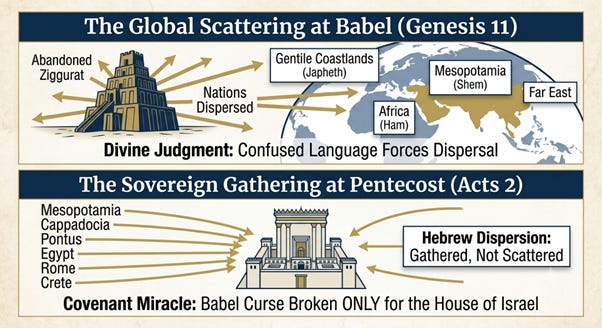
Acts 2:9-11 LSB “Parthians and Medes and Elamites, and residents of Mesopotamia, Judea and Cappadocia, Pontus and Asia, (10) Phrygia and Pamphylia, Egypt and the district of Libya around Cyrene, and visitors from Rome, both Jews and proselytes, (11) Cretans and Arabs—we hear them in our own tongues speaking of the mighty deeds of God.”
This specific geographic footprint traces the exact paths of the Assyrian, Babylonian, and Roman dispersions of the Hebrew nation.
These were not Gentiles; they were the Jewish Diaspora—descendants of the scattered northern and southern kingdoms of Israel who had lived for generations in exile among the pagan nations.
Because they were born and raised in foreign lands, they had completely lost their ancestral Hebrew or Aramaic tongue. They grew up speaking the regional languages of the empires they inhabited.
Thus, the precise nature of the Pentecost miracle must be defined with extreme care. God did not eliminate different languages across the globe on that day.
The Gentile nations (the descendants of Japheth and Ham who had been scattered across the coastlands at Babel) remained, and continue to remain to this day, under the linguistic boundaries established in Genesis 11.
The Roman soldier in Britain still spoke Latin; the Germanic tribes still spoke their native dialects; the Han Dynasty in China still spoke Chinese. The Babel curse was not lifted from the pagan world in Acts 2.
Rather, the miracle was a focused, sovereign cancellation of the Babel curse exclusively within and for the covenant house of Israel.
The Holy Spirit supernaturally empowered the Galilean Apostles to bypass the linguistic barriers that separated the scattered Jews.
When Peter and the eleven stood up, they spoke, and the Holy Spirit translated their words into the precise dialektos, the intelligible, existing human languages of every scattered Jewish tribe present.
The message was clear: The linguistic judgment that had kept the tribes of Israel fragmented and isolated from one another during their long exile was over.
Under King Jesus, the scattered sheep of the house of Israel were being linguistically and covenantally re-gathered into one single, unified spiritual body.
Pentecost was a national covenant restoration for Israel, executed through the supernatural bridging of the Babel divide.
Part IV: The Modern Hermeneutical Divergence
Edward Irving and the Genesis of Modern Pentecostalism
Having anchored the historical and covenantal realities of Genesis 11 and Acts 2, we must now address a significant hermeneutical divergence that has impacted the modern church.
For the first eighteen centuries of church history, Christian theologians overwhelmingly maintained that the miracle of tongues in Acts 2 consisted entirely of known, structured, intelligible foreign human languages (the dialektos in Greek), given as a specific sign to validate the arrival of the New Covenant to the Jewish people.
However, in the mid-19th century, a radical interpretive shift occurred that fundamentally altered the theological landscape of the Western church.
This shift can be traced directly to the life and ministry of Edward Irving (1792–1834), a brilliant but erratic Scottish Presbyterian minister who pastored the National Scotch Church in Regent Square, London.
Irving became deeply consumed by predictive prophecy and apocalyptic timelines. He came to believe that the church was entering the final days of the dispensation of grace and that the “latter rain” of the Holy Spirit was about to fall.
He argued that the institutional church had lost its power because it had allowed the miraculous gifts of the Spirit, specifically prophecy and tongues, to cease.
In 1831, within Irving’s congregation, members began experiencing sudden, emotional outbursts of speech that were completely untranslatable and chaotic.
Rather than testing these manifestations against the strict context of Scripture, Irving embraced them as a genuine restoration of the apostolic gift of tongues.
He developed a new theological framework that isolated the phenomenon of speaking in tongues from its historical, covenantal, and linguistic roots, elevating it instead into a universal sign of personal spiritual empowerment.
Although Irving’s movement, the Catholic Apostolic Church, ultimately fractured and dwindled, his theological innovation laid the direct foundation for the early 20th-century developments at Bethel Bible College in Topeka, Kansas, under Charles Parham, and for the subsequent Azusa Street Revival in Los Angeles (1906), led by William J. Seymour.
These movements popularised the doctrine that speaking in an un-translatable, ecstatic tongue is the essential, mandatory outward sign of receiving the “Baptism in the Holy Spirit,” an experience they decoupled from regeneration and treated as a distinct prerequisite for the fullness of the Christian life.
The Anatomy of a Faulty Hermeneutic
The foundational error of the Irvingite and modern Pentecostal movements lies in a classic category mistake—an interpretive fallacy wherein two entirely different concepts are treated as identical simply because they share a superficial vocabulary.
To illustrate this hermeneutical breakdown, we can contrast the textual data of Acts 2 with the functional practices of modern experiential movements:
The Biblical Reality (Acts 2)
Linguistic Character - Intelligible, structured human languages ( the dialektos).
Primary Target Audience - The scattered Hebrew Diaspora (Jews of the Dispersion).
Covenantal Objective - Reversal of the Babel judgment; national restoration of Israel.
Textual Context - Public sign of historical, redemptive transition.
The Experiential Model (Modern)
Linguistic Character - Unintelligible, non-human, emotional utterances.
Primary Target Audience - The individual believer seeking an internal experience.
Covenantal Objective - Personal validation of spiritual status or secondary baptism.
Textual Context - Private devotion or uninterpreted corporate outbursts.
The modern experiential model relies heavily on taking Paul’s pastoral corrections in 1 Corinthians 14 regarding private prayer and emotional expressions, and retroactively forcing them into the historical narrative of Acts 2.
When Paul speaks of one who “utters mysteries in the spirit” and “builds up himself” (1 Corinthians 14:2–4), he is diagnosing and correcting a highly dysfunctional, chaotic local church culture in Corinth that had corrupted the spiritual gifts into a form of pagan self-exaltation.
To take Paul’s description of a corrected problem in an isolated church and turn it into a normative definition for the historic miracle of Pentecost is an egregious violation of basic biblical interpretation.
Furthermore, the claim that “babbling in a strange tongue” serves as the definitive sign of being born again or baptised in the Spirit directly contradicts the explicit teaching of the New Testament.
In 1 Corinthians 12:30, Paul asks a series of rhetorical questions designed to emphasise diversity within the body of Christ:
1 Corinthians 12:30 LSB Do all have gifts of healings? Do all speak with tongues? Do all translate?
The clear grammatical structure of the Greek text requires a resounding answer of “No.”
By turning an experiential manifestation into a rigid metric for salvation or spiritual maturity, modern movements have inadvertently instituted a new form of spiritual elitism.
This is a profound irony, as it mirrors the exact sin of Babel: utilising human-centric metrics to make a name for oneself and construct an exclusive, elite spiritual identity.
Conclusion: The Spiritual and Pastoral Lessons for Today
Reclaiming Historical Literacy
The trajectory from the tower of Babel in Genesis 11 to the temple court in Acts 2 provides crucial lessons that contemporary believers must urgently internalise.
The first lesson is the critical need to reclaim absolute confidence in the biblical record’s historical literacy.
When the church treats the early chapters of Genesis as flexible poetry, abstract allegory, or accommodation to ancient mythological concepts, it cuts the legs out from under biblical authority.
If the chrono genealogies of Genesis 11 are not accurate down to the year, then the timeline of human history is shifted onto secular, uniformitarian models that require millions of years of death, disease, and random evolutionary struggle long before the arrival of Adam.
This compromise ultimately destroys the gospel itself, as it detaches the entry of human death from Adam’s historic sin in space and time (Romans 5:12).
Romans 5:12 LSB Therefore, just as through one man sin entered into the world, and death through sin, and so death spread to all men, because all sinned—
The detailed precision of Shem's lineage reminds us that our faith is anchored in a real world, with real years, tracked by a real Creator who has left an uncompromised written record of His work.
Reclaiming Covenantal Unity Over Experiential Chaos
The second lesson demands that we elevate the corporate, objective reality of the Gospel over subjective, individualised experiences.
The miracle of Pentecost was not given to provide individual believers with an intense emotional experience to validate their personal standing before God.
Pentecost was a sweeping, historic demonstration of King Jesus executing His royal authority to break the power of the Babel judgment over the scattered house of Israel.
It was an objective declaration that the old covenant boundaries were being redrawn, that the scattered tribes were being brought home, and that the long-awaited Messianic Kingdom had been established.
When the modern church downplays this magnificent covenantal framework in favour of chasing emotional, ecstatic manifestations, it exchanges a vast inheritance for a temporary, personal high.
True spiritual unity, the genuine reversal of the Babel curse, is not achieved through forcing uniform emotional experiences or babbling in subjective tongues.
True unity is realised when believers from every cultural and linguistic background bow the knee to the objective authority of Scripture, confessing with clear, intelligible speech that Jesus Christ is Lord to the glory of God the Father.
As we navigate an increasingly fractured culture that seeks to build its own secular towers of centralisation and self-deification, let the church stand firmly on the twin pillars of Genesis 11.
Let us trust the meticulous history of the text and let us live out the beautiful reality of a covenant people gathered, healed, and sustained by the sovereign power of the Holy Spirit.
Many blessings
Geoff


