



The modern debate surrounding the age of the Earth is rarely a battle over raw data; it is fundamentally a battle over authority, hermeneutics (the method of biblical interpretation) and the integrity of language.
For generations, compromising positions such as the Day-Age theory, the Gap theory, and Framework Hypotheses have sought to inject secular deep-time frameworks (millions and billions of years) into the opening chapters of Scripture.
However, when the Bible is allowed to interpret itself, these compromised frameworks shatter.
By tracing a direct literary line from the meticulous, calendar-dated logbook of the global Flood in Genesis 8, back through the strict grammatical locks of the Creation week in Genesis 1, and forward to the ultimate structural anchor of the human workweek in Exodus 20 and 31, we uncover an airtight, internally consistent historical narrative. God did not write early Genesis in the vague, misty language of myth or poetry. He wrote it as standard, eyewitness history, completely incompatible with an Earth of millions of years.
The Logbook of the Flood: Genesis 8 as a Chronological Anchor
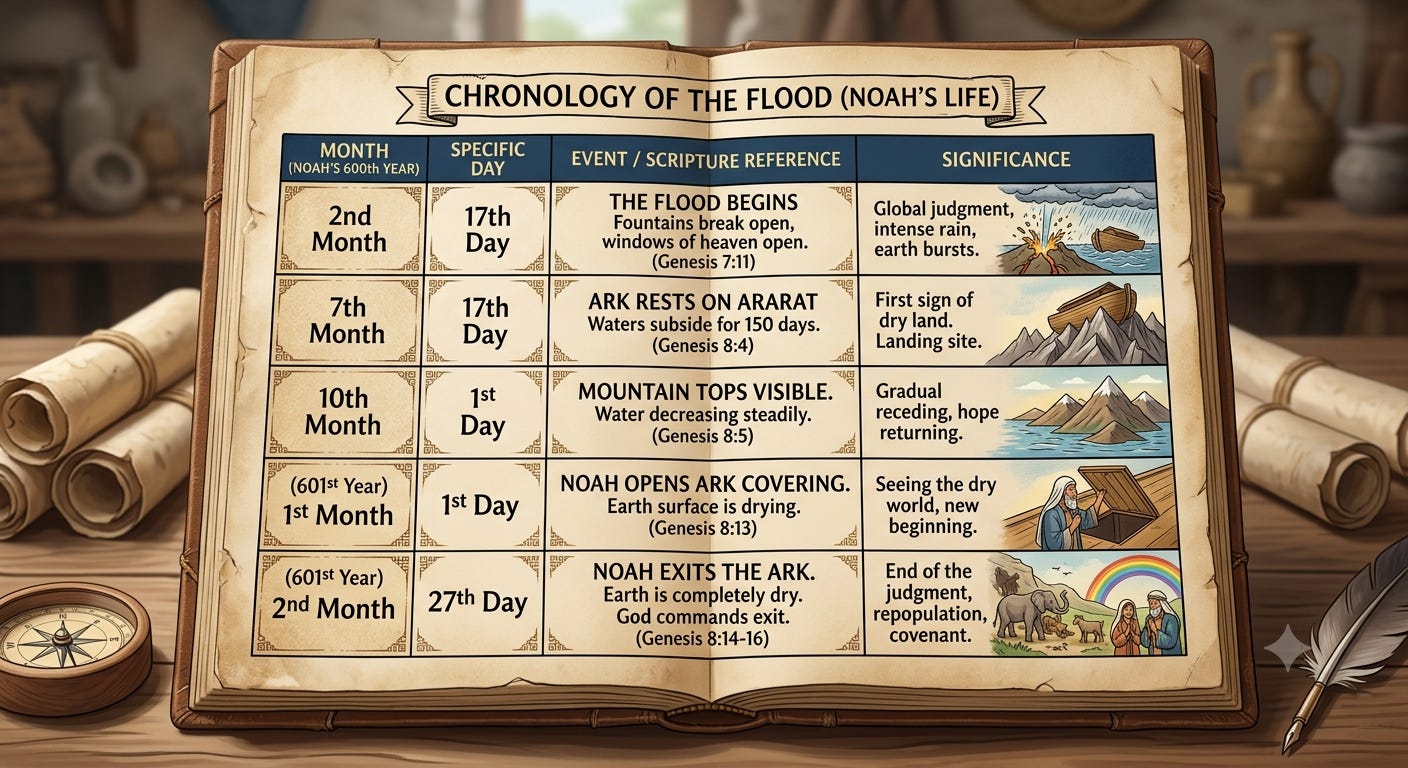
One of the most devastating blows to any old-earth compromise is the sheer mathematical and chronological rigidity of the Genesis Flood account. Compromising theories rely heavily on the assertion that early Genesis uses fluid, poetic, or symbolic language. Yet, when we step into Genesis chapters 7 and 8, we encounter a text that reads exactly like a captain’s logbook or a legal diary.
God does not use vague generalities like “after a long season” or “during a certain epoch.” Instead, the Holy Spirit guides the writer to record specific calendar dates based on the precise months and days of Noah’s life.
Consider the highly calculated timeline of the global cataclysm:
Genesis 7:11
Calendar Date (Noah’s Life) - Year 600, 2nd Month, 17th Day
The Event and Its Chronological Value - The fountains of the great deep burst open; windows of heaven open. The Flood begins.
Genesis 8:3–4
Calendar Date (Noah’s Life) - ear 600, 7th Month, 17th Day
The Event and Its Chronological Value - The waters recede continuously; the Ark rests on the mountains of Ararat.
Genesis 8:5
Calendar Date (Noah’s Life) - Year 600, 10th Month, 1st Day
The Event and Its Chronological Value - The waters decrease steadily until the tops of the mountains become visible.
Genesis 8:13
Calendar Date (Noah’s Life) - Year 601, 1st Month, 1st Day
The Event and Its Chronological Value - The waters are dried up from the earth; Noah removes the covering of the Ark.
Genesis 8:14
Calendar Date (Noah’s Life) - Year 601, 2nd Month, 27th Day
The Event and Its Chronological Value - The Earth is completely dry. God commands Noah to exit the Ark.
The 150-Day Anchor and Mathematical Precision
This timeline contains an incredible mathematical relationship that completely destroys the concept of fluid, allegorical time in early Genesis.
Genesis 7:24 explicitly states that the waters prevailed on the earth for 150 days. Genesis 8:3–4 tells us that the waters receded, and the Ark came to rest on the seventeenth day of the seventh month.
By calculating the duration between the start date (2nd month, 17th day) and the resting date (7th month, 17th day), we find a span of exactly five months. If five months equals exactly 150 days, then each month consists of precisely 30 days.
This reveals that the author of Genesis was tracking time using a literal, standard calendar. This is real-world history, tied to the predictable orbital cycles of the Earth and Moon.
Narrative Uniformity and Grammatical Consistency
The presence of this literal logbook in Genesis 8 creates a profound literary problem for Day-Age theorists. In classical Hebrew, the grammatical structure used to convey historical facts is distinct from that used in Hebrew poetry or wisdom literature. Genesis 1 through 11 is composed entirely in this historical narrative style, dominated by what grammarians call waw-consecutive verbs (sequential actions moving a true story forward).
There is zero grammatical transition, shift in style, or literary boundary between the “days” of Genesis 1, the genealogies of Genesis 5, and the calendar dates of Genesis 8. They are parts of a single, continuous historical tapestry.
If we recognise that the “days” and “months” in Genesis 8 represent literal 24-hour days and 30-day months, we have absolutely no grammatical justification to isolate Genesis 1 and declare its “days” to be vast geological epochs. Doing so violates the rules of narrative uniformity. If the text says “day” in a continuous historical narrative, it means a literal day throughout.
Deciphering the Code of Genesis 1: The Contextual Rules of Yôm
To bypass this narrative consistency, old-earth proponents frequently point to the Hebrew word for day, yôm (), noting that it can occasionally refer to an indefinite period, such as in the phrase “the day of the Lord” or “in the day that the Lord made the earth” (Genesis 2:4).
Ministries like Answers in Genesis have thoroughly answered this claim by demonstrating that words do not dictate meaning in a vacuum—context determines meaning.
While yôm can mean an indefinite period in poetic, prophetic, or idiomatic settings, its meaning in classical Hebrew prose is strictly bound by surrounding grammatical qualifiers. When we survey the entire Old Testament, we discover four distinct contextual rules that lock the meaning of yôm into a literal 24-hour cycle. Genesis 1 applies every single one of them.
Rule 1: Yôm Coupled with a Number
Whenever the word yôm is modified by a specific number—whether a cardinal number (one, two, three) or an ordinal number (first, second, third)—it always refers to a literal, 24-hour day in Hebrew prose.
Outside of Genesis 1, there are 359 distinct instances where a number modifies the word yôm.
In Numbers 7, the princes of Israel bring their offerings on twelve consecutive, numbered days. No theologian argues that these were twelve vast geological epochs.
In Joshua 6, Israel marches around Jericho for six numbered days and seven times on the seventh numbered day. These are universally understood as normal, literal days.
In Genesis 1, God explicitly attaches numbers to every single day of the creation week: “And there was evening and there was morning, the first day” (Genesis 1:5), followed systematically by the second, third, fourth, fifth, sixth, and seventh days. To claim these are millions of years requires rejecting the uniform grammatical usage found throughout the rest of the Hebrew Bible.
Rule 2: The Pairing of “Evening” and “Morning”
The text of Genesis 1 does not merely state “the first day.” It frames each day with a structural boundary: “And there was evening (‘ereb*) and there was morning (bōqer)...”*
The terms “evening” and “morning” are physical markers tied to the rotation of the Earth relative to a light source, defining the start and end of a literal night-and-day cycle.
Outside of Genesis 1, the words “evening” and “morning” appear together within the same verse 38 times. In every single instance, without exception, they refer to the boundaries of a literal, normal day. For example, the daily tabernacle sacrifices were commanded to be offered in the “morning” and the “evening”—a literal, twice-daily ritual. When yôm appears alongside either “evening” or “morning” outside of Genesis 1 (which occurs 67 times), it likewise always indicates a standard 24-hour day.
Rule 3: The “Triple Lock” of Grammar
Genesis 1 does not just use a number, nor does it just use the terms evening and morning. It combines them simultaneously. Every single day of the creation week is defined by a number and the evening/morning boundary. Grammatically, this functions as a triple lock on the literal interpretation. If a number forces a literal day, and the evening/morning phrase forces a literal day, their combination leaves absolutely zero room for allegorical evasion.
Rule 4: The Contrast with “Night”
When yôm is directly contrasted or paired with “night” (laylāh), its meaning is immediately restricted. It refers either to the daylight portion of a literal 24-hour cycle or to the full 24-hour cycle itself.
Throughout the Old Testament, this pairing occurs 53 times (such as Moses on Mount Sinai for forty days and forty nights), and it consistently indicates literal time.
On the very first day of creation, God defines His terms: “God called the light Day, and the darkness he called Night” (Genesis 1:5). God established the definitive dictionary for the rest of human history right here. He explicitly ties yôm to the light cycle, contrasting it directly with the dark cycle (night).
The Lexical Reality of the Hebrew Language
If God had intended to communicate that He created the universe over vast millions of years, the ancient Hebrew language would have possessed the vocabulary perfectly suited for that task. The word ‘ôlām (), for instance, means a long, indefinite age, an epoch, or eternity. God could have easily stated that He created the heavens and the earth over six ‘ôlāmîm.
Instead, He purposefully chose yôm and reinforced it with numbers, as well as evenings, mornings, and nights. To twist these explicit linguistic boundaries into millions of years is an exercise in text-distortion, not biblical exegesis.
The Ultimate Anchor: Exodus 20 and 31 and the Sovereign Finger of God
While the internal grammar of Genesis 1 and 8 is solid, God chose to seal the literal 24-hour interpretation of the creation week inside the moral law of Israel. The most explicit, unyielding cross-references defending a Young Earth are found in the books of Law, specifically written by the very finger of God on tablets of stone.
Exodus 20:11 — The Structural Foundation of Human Existence
In the giving of the Ten Commandments at Mount Sinai, God establishes the blueprint for human labour and rest. The Fourth Commandment states:
Exodus 20:8-11 LSB “Remember the sabbath day, to keep it holy. (9) “Six days you shall labor and do all your work, (10) but the seventh day is a sabbath of Yahweh your God; in it you shall not do any work, you or your son or your daughter, your male or your female slave or your cattle or your sojourner who is within your gates. (11) “For in six days Yahweh made the heavens and the earth, the sea and all that is in them, and rested on the seventh day; therefore Yahweh blessed the sabbath day and made it holy.
Here, God establishes an explicit structural link between the human workweek and the creation week. The command for man to work six literal days and rest on the seventh literal day is explicitly based on the pattern of the original Creation week.
If the days of Genesis 1 were actually millions of years long, the commandment becomes completely irrational. Man cannot labour for six million years and rest for an epoch. The analogy only functions if the structural units of time are identical. God tells us that our seven-day week is a direct, literal copy of His creation week.
Exodus 31:17 — The Sign of the Covenant
God reinforces this truth even more intensely later in Exodus. As He finishes speaking with Moses on Mount Sinai, He commands him regarding the Sabbath as a perpetual sign of the Mosaic covenant:
Exodus 31:17-18 LSB “It is a sign between Me and the sons of Israel forever; for in six days Yahweh made heaven and earth, but on the seventh day He rested and was refreshed.” (18) When He had finished speaking with him upon Mount Sinai, He gave Moses the two tablets of the testimony, tablets of stone, written by the finger of God.
This text elevates the conversation beyond mere human interpretation or literary analysis. This is a direct statement from the Creator Himself, engraved into stone so it could not be altered.
The phrase “and was refreshed” (wayyināpaš) is a deeply personal, anthropomorphic term used to describe God stopping His creative work to delight in its completeness.
If creation took billions of years of slow, agonising evolutionary struggle, death, and natural selection, the idea of God stepping back on a literal seventh day to be “refreshed” by a blood-stained planet is completely foreign to the text. Exodus 31 anchors the timeline of the universe directly to the physical, historical experience of humanity.
The Theological Catastrophe of Deep-Time Compromises
Beyond the severe grammatical problems it creates, trying to merge millions of years with the biblical text causes a major theological collapse. Many Christians do not realise that the secular timeline of millions of years is not derived from stars or oceans; it is derived from the interpretation of sedimentary rock layers around the globe.
According to secular geology, these massive rock strata represent a slow ledger of billions of years of Earth history.
However, these exact same rock layers contain billions of fossils. Fossils are the preserved remains of dead things. The fossil record is a physical archive of death, violent destruction, disease (such as fossilised tumours and arthritis found in dinosaur bones), and animals tearing each other apart.
The Problem of Death Before Sin
If an old-earth model is correct, then those billions of fossils—and the millions of years of agony, carnivory, suffering, and decay they represent—must have occurred long before Adam ever appeared on the Earth.
This directly contradicts the explicit theology of the New Testament regarding the entry of death into the universe.
Secular/Old-Earth Timeline:
[Millions of Years of Death, Disease, & Fossilisation] ──> [Adam Created] ──> [The Fall/Sin]
Biblical/Young-Earth Timeline:
[Six Days of Perfect Creation: “Very Good”] ──> [The Fall/Sin] ──> [Death Enters Universe] ──> [Global Flood Strata]
The Bible is unmistakably clear that death is not a natural, original part of creation. It is an enemy that entered the world as a direct consequence of human rebellion:
Romans 5:12 LSB Therefore, just as through one man sin entered into the world, and death through sin, and so death spread to all men, because all sinned—
Romans 8:20-21 LSB For the creation was subjected to futility, not willingly, but because of Him who subjected it, in hope (21) that the creation itself also will be set free from its slavery to corruption into the freedom of the glory of the children of God.
If millions of years of animal death, cancer, and bloodshed happened before the Fall, then:
1. Death is not the penalty for sin. It existed long before Adam’s rebellion.
2. God is the author of disease and suffering. If rock layers containing cancer and predatory violence were laid down before Adam, then God looked down at billions of years of suffering at the end of Day 6 and pronounced it “very good” (Genesis 1:31).
This strips the gospel of its foundational logic. If death is not the dynamic consequence of sin, then Christ’s physical death on the cross cannot purchase redemption from the effects of sin. The entire redemptive narrative relies on a literal historical sequence: a perfect creation, ruined by a literal man (Adam), to be redeemed by a literal man (Jesus Christ).
The Geological Witness: Rescuing the Earth from Deep Time
If we reject the millions of years of slow accumulation, how do we account for the thousands of feet of sedimentary rock and billions of fossils blanketing the globe?
The answer brings us right back to the historical record of Genesis 7 and 8.
A year-long, catastrophic global Flood is the perfect scientific mechanism for explaining Earth’s geology. The text describes a cataclysmic breakdown of the Earth’s crust: “all the fountains of the great deep were broken up” (Genesis 7:11). This points to massive tectonic activity, global volcanic eruptions, and tsunamis sweeping across the continents.
Rapid Burial, Not Slow Accumulation
For a fossil to form, an organism cannot die naturally in a field or ocean and slowly rot over thousands of years. It must be buried rapidly under tremendous amounts of sediment to seal it away from scavengers and oxygen.
The rapid rises and falls of the water levels documented throughout the year-long timeline of the Flood provide the exact conditions needed to form the massive geological layers we see today.
Instead of representing millions of years of slow evolution, the fossil record represents a monumental graveyard created by a global judgment. The “dinosaur ages” are not eras hidden in the deep past; they are simply ecosystems of the pre-Flood world, trapped and buried rapidly in the mud of Noah’s Flood. Genesis 8 explains the rocks, completely removing any need for deep time.
The Testimony of Jesus Christ
Ultimately, the argument for a literal Genesis and a young universe is anchored by the supreme authority of Jesus Christ. Whenever Jesus addressed early Genesis, He treated it as straightforward, plain history.
In Mark 10:6, Jesus addresses the origin of marriage by stating: “But from the beginning of the creation, God made them male and female.’”
If the secular timeline were true (where the universe begins 14 billion years ago, Earth forms 4.5 billion years ago, and humans only emerge in the last fraction of a millimetre of the timeline), Jesus’s statement would be completely wrong. On that timeline, humanity arrives at the very end of creation.
In the Young Earth timeline, where Adam and Eve are created on Day 6 of a literal week, they are indeed living right at the beginning of cosmic history. Jesus, the Creator Himself (John 1:3), explicitly verified that humanity has been present since the beginning of creation.
Conclusion: The Ultimate Authority of the Text
When we synthesise the biblical data, we discover a beautifully unified testimony. Genesis 8 records a timeline with crisp, mathematical calendar dates, proving that early biblical prose handles time with strict literal precision.
This literal handling of time is anchored by the four explicit contextual rules governing the Hebrew word yôm in Genesis 1. God then takes this literal six-day creation structure and writes it with His own finger on tablets of stone in Exodus 20 and 31, building the human week upon it.
To inject millions of years into this flawless structure requires discarding the basic rules of grammar, introducing structural nonsense to the Ten Commandments, and making God the creator of death and disease long before sin entered the world.
By standing firmly on the textual specificity of Genesis 8, Genesis 1, and Exodus 31, we see that Scripture leaves no room for millions of years. The Bible records a recent, perfect creation, a catastrophic global judgment, and a world that testifies to the absolute truth of God’s Word from the very first verse.
Blessings
Geoff
My Jesus-given purpose is to support the remnant. For a full explanation of this purpose, click this link.


