


Genesis 9 serves as one of the most profound hinge points in all of ancient literature.
It is the story of humanity’s ultimate hard reset.
The floodwaters have receded, the ark has come to rest, and Noah and his family step out into a damp, quiet, and completely empty world.
If we approach this text carefully, we find that it is sharply divided into two distinct acts.
The first half of the chapter takes our gaze upward to the clouds, where we witness an overwhelming cosmic display of God’s grace and covenant loyalty.
The second half of the chapter abruptly drags our gaze back down to the dirt, straight into the dark, claustrophobic corners of a family tent, where a single night of moral failure fractures the future of global history.
To fully grasp the weight of this narrative, we must unpack it slowly.
We must look at the Hebrew linguistics, the ancient Near Eastern cultural context, and the theological threads that weave from this muddy mountainside all the way through the tapestry of the biblical story.
Part I: The Architecture of Chesed (Genesis 9:1-17)
When Noah steps off the ark, the lingering question in the air concerns divine temperament. The world has just been destroyed.
What kind of God is humanity dealing with now?
Is He a God of volatile wrath, waiting for the next inevitable human failure so He can strike again?
God’s immediate response dismantles that fear.
The first seventeen verses of Genesis 9 are an absolute masterclass in a Hebrew concept known as Chesed.
The Re-Commissioning of Humanity
Before God issues any new laws, He issues a blessing. God looks at this tiny, traumatised remnant of humanity and speaks familiar words.
Genesis 9:1 LSB And God blessed Noah and his sons and said to them, “Be fruitful and multiply, and fill the earth.
If you trace the biblical narrative back just a few pages, you will recognise these exact words. This is the precise mandate given to Adam and Eve in the Garden of Eden (Genesis 1:28).
This is deeply significant.
Despite the catastrophic fracture of human sin, despite the violence that led to the flood, God’s original, beautiful design for humanity to flourish remains entirely unchanged.
This is the essence of Chesed.
Chesed is used 249 times in the Old Testament
Chesed is notoriously difficult to translate into English.
It is mostly translated as “mercy” (137 times in the KJV). But that fails to unlock the true nature of God’s covenantal love, called in the Greek New Testament “agape”. Chesed is often also rendered as “lovingkindness (26 times in the KJV),” or “kindness (40 times in the KJV).”
Similarly, we have difficulty translating the Greek “agape” because English has only one word for love. The depth of God’s covenantal love is spiritual in nature and reserved for those born-again in Jesus.
But it is much more than a warm emotion.
In the ancient world, Chesed is a relational commitment.
It is the conscious decision of the stronger, superior party in a relationship to bind themselves to the weaker, inferior party. It is a promise to protect, provide, and remain loyal, even when the weaker party brings nothing to the table.
By reiterating the Edenic blessing, God is acting out His Chesed by restoring a broken people back to their noble, original purpose without requiring them to earn it back first.
The Sanctity of Life in a Broken World
While the blessing remains the same, the environment has drastically changed. The post-flood world is harsher, and human nature, as God acknowledged in Genesis 8:21, is still inherently flawed.
Because of this, God introduces new provisions and new boundaries to sustain life.
God grants humanity authority over the animal kingdom in a new way, expanding their diet to include meat.
However, this freedom comes with a severe and highly specific limitation.
Genesis 9:3 LSB “Every moving thing that is alive shall be food for you; as with the green plant, I give all to you.
To the modern reader, this might just sound like an ancient dietary restriction, but its theological implications are massive.
In ancient Near Eastern thought, blood is the physical representation of the soul, the life-force, the animating breath of a creature. By commanding humanity to drain the blood before consuming the meat, God is embedding a profound reverence for life into the daily rhythm of human survival.
God is essentially saying: You may take the life of an animal to sustain your own life, but you must never forget that life itself is sacred, and the life-force belongs exclusively to Me.
This reverence for life is immediately extended and amplified regarding human beings. God institutes a strict accounting for human bloodshed.
Genesis 9:6 LSB “Whoever sheds man’s blood, By man his blood shall be shed, For in the image of God He made man.
This is not merely an ancient code of vengeance; it is the establishment of human justice based on divine worth. To murder a human being is to assault the very image of the Creator.
God’s Chesed is so fierce that He demands the highest possible protection for human life.
The Weapon Hung in the Sky
The ultimate climax of God’s covenant loyalty is painted across the sky.
God establishes what theologians call the Noahic Covenant, and He seals it with a spectacular visual sign.
Genesis 9:13 LSB I put My bow in the cloud, and it shall be for a sign of a covenant between Me and the earth.
When we read the word “rainbow” in modern English, we associate it with watercolours, prisms, and gentle rainstorms. It feels soft and peaceful. But the original Hebrew word used in this text is qeshet.
Qeshet means a bow, and specifically, a warrior’s bow. A weapon of war. It is the exact same word used throughout the Old Testament to describe the bows carried by archers in battle.
This radically changes the imagery of the scene.
The Almighty Creator takes His weapon of judgment (the very bow that had just rained down cosmic destruction upon a deeply corrupt world) and hangs it in the clouds.
He retires His weapon.
Furthermore, look at the orientation of the bow. An archer’s bow is curved. The string is pulled back toward the archer, while the curved wood faces the target. When God places His bow in the sky, the curve is pointing upward, away from the earth, toward the heavens.
God is effectively declaring, “If this weapon of ultimate destruction is ever fired again, the arrow will point at Me, not at you.”
This is the ultimate display of chesed.
The Noahic Covenant is what ancient treaty scholars call a unilateral covenant.
In a bilateral covenant, both parties have conditions to meet (e.g., “If you obey me, I will bless you; if you disobey, I will punish you”).
But here, God makes a one-sided promise.
He binds Himself to protect the rhythm of creation, seedtime and harvest, cold and heat, summer and winter, regardless of humanity’s future behaviour.
God knows that humans will fail again.
He knows the heart is still prone to evil. Yet, in an act of breathtaking Chesed, He guarantees that the earth will never again face a total watery reset.
The overarching canopy of grace has been established.
Part II: The Fracture in the Tent (Genesis 9:18-29)
If the chapter ended at verse 17, it would be a perfect, tidy conclusion to the flood narrative. But the Bible is relentless in its honesty about the human condition.
As we cross into verse 18, the narrative takes a deeply uncomfortable turn.
We leave the sprawling skies, the magnificent rainbow, and the cosmic promises, and we zoom down into the dirt.
The Vineyard and the Fall of the Hero
The text tells us that Noah, a man of the soil, planted a vineyard.
Genesis 9:21 LSB And he drank of the wine and became drunk and uncovered himself inside his tent.
This is a tragic and sobering moment.
Noah was the man who “found favour in the eyes of the Lord” (Gen 6:8).
He was the righteous man, blameless in his generation, who faithfully built the ark for decades while the world mocked him. Yet here, in the quiet aftermath of salvation, the hero falls.
There is a profound theological truth embedded here: The floodwaters were incredibly effective at washing away the corrupt population of the earth, but they were entirely incapable of washing away the capacity for sin inside the human heart. The infection survived the flood. It rode on the ark.
Noah partakes of the fruit of the new earth, loses control of his senses, and lies naked and vulnerable inside his tent. He creates an environment of dishonour, setting the stage for a family crisis that will ripple through millennia.
2. The Sin of Ham and the Honor of His Brothers
Enter Ham, the father of Canaan.
Genesis 9:22 LSB Then Ham, the father of Canaan, saw the nakedness of his father and told his two brothers outside.
Why does this single moment trigger such massive biblical consequences?
To understand, we must view this through the lens of the ancient Near East.
In patriarchal societies, the authority, dignity, and honour of the father were paramount. To “see the nakedness” of a patriarch was not merely an accidental glance; it was a profound breach of respect.
Furthermore, Ham does not immediately cover his father or protect his dignity. Instead, he goes outside and tells his brothers.
Scholars debate the exact nature of Ham’s sin. Whether it was purely voyeurism, a mocking usurpation of patriarchal authority, or something darker, is all conjecture.
But at the very least, Ham’s actions reveal a heart of rebellion. He exploits his father’s vulnerability, turning a moment of shame into a spectacle. He disrespects the very man through whom God saved humanity.
The contrast with his brothers, Shem and Japheth, is striking.
Genesis 9:23 LSB But Shem and Japheth took the garment and laid it upon both their shoulders and walked backward and covered the nakedness of their father; and their faces were turned backward, so that they did not see their father’s nakedness.
Shem and Japheth model a completely different spirit.
They refuse to participate in the dishonour.
By walking backward with a garment draped across their shoulders, they actively protect their father’s dignity, refusing even to look upon his shame.
It is a beautiful, restorative act of honour amidst a moment of deep familial degradation.
3. The Curse of Canaan
When Noah wakes up from his wine and realises what his youngest son has done to him, he speaks a heavy, prophetic word.
But strangely, he does not curse Ham directly.
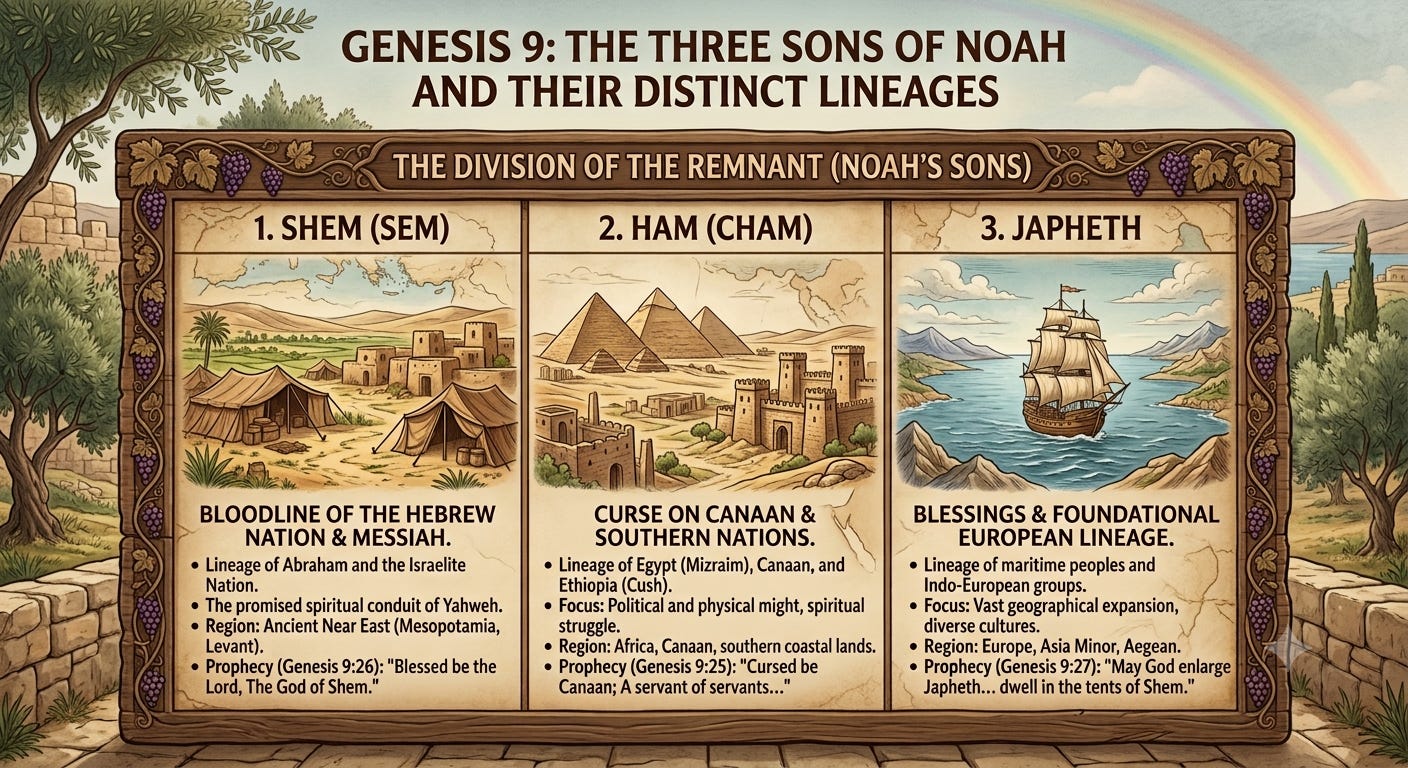
Genesis 9:25 LSB So he said, “Cursed be Canaan; A servant of servants He shall be to his brothers.”
Why does Noah curse Canaan, Ham’s son, instead of Ham himself?
Theologically, God had already blessed Noah and his sons (including Ham) in verse 1. Noah cannot curse a man whom God has explicitly blessed. Therefore, the prophetic curse falls upon Ham’s lineage, specifically, the line of Canaan.
Historically and literarily, this moment serves as a critical setup for the Old Testament’s grand trajectory.
The original audience of the book of Genesis was the Israelite nation (the descendants of Shem) as they prepared to enter the Promised Land, which was inhabited by the Canaanites.
Moses, the author of Genesis, is showing the Israelites the ancient, ancestral root of Canaanite corruption. The moral decay, the idolatry, and the vile practices of the Canaanite nations that Israel would later encounter did not happen in a vacuum; they were the outworking of a rebellious, dishonourable spirit that began in a tent generations earlier.
4. The Blessings and the Bloodlines
Noah then turns his attention to his other two sons, and the words he speaks over them sketch out a stunning geopolitical and spiritual map of human history.
The Blessing of Shem (The Messianic Line)
Genesis 9:26 LSB And he said, “Blessed be Yahweh, The God of Shem; And let Canaan be his servant.
Notice the precise phrasing.
Noah does not simply say, “Blessed be Shem.” He says, “Blessed be Yahweh, the God of Shem.” By doing this, Noah explicitly links Yahweh, the one true God, to the bloodline of Shem.
This establishes Shem as the spiritual custodian of God’s truth.
From the line of Shem (the “Shemites” or Semitic peoples) will come Abraham. From Abraham will come Isaac, Jacob, and the twelve tribes of Israel.
Through this specific lineage, God will deliver the Holy Scriptures, the covenants, the prophets, and ultimately, the promised Messiah, Jesus Christ.
The spiritual salvation of the world is anchored to the tent of Shem.
The Blessing of Japheth (The Gentle Expansion)
Genesis 9:27 LSB “May God enlarge Japheth, And let him dwell in the tents of Shem; And let Canaan be his servant.”
Noah’s words over Japheth are a fascinating piece of prophecy.
First, there is the promise of physical expansion: “May God enlarge Japheth.” Geographically and historically, the descendants of Japheth migrated north and west. They became the foundational bloodlines of the Indo-European nations, the maritime peoples of the Mediterranean, and eventually the vast populations of Europe and Asia Minor. They truly were “enlarged” across the globe.
It would be appropriate to point out that it is highly likely that the nations of Europe, Britain, USA, and Australia/New Zealand, were from the line of Japheth.
But the second half of the prophecy is deeply spiritual: “And let him dwell in the tents of Shem.”
What does it mean for the sprawling, expanding line of Japheth to dwell in the tents of Shem?
It is a beautiful, early hint of spiritual inclusion.
While the bloodline of the Messiah and the oracles of God stayed exclusively with Shem (Israel), a day was coming when the descendants of Japheth—the Gentile nations—would be invited to share in that exact same spiritual inheritance.
This prophecy finds its ultimate fulfilment in the New Testament, when the Gospel of Jesus Christ breaks out of its Jewish boundaries and expands into the Gentile world.
Through Christ, the Gentiles (Japheth’s descendants) are welcomed into the household of faith. They are invited out of the cold and brought into the warmth and grace of Shem’s tent, where Jews and Gentiles alike worship the same God under the same roof.
Conclusion: Standing Between Grace and Gravity
Genesis chapter 9 concludes with a simple, quiet epitaph.
Genesis 9:28-29 LSB And Noah lived 350 years after the flood. (29) So all the days of Noah were 950 years, and he died.
The great hero of the flood passes away, leaving us standing in a strange, profound tension.
On one hand, we are meant to look up at the sky and see the qeshet, the rainbow. It stands as the grand, unshakeable monument of God’s Chesed. It is the visible guarantee of His loving loyalty to a broken creation, a promise that His grace will always hold the universe together.
On the other hand, we are meant to look down at the dirt.
We are forced to acknowledge the brokenness of human families, the generational fractures caused by our own sins, and the heavy gravity of our flaws. The flood did not fix the human heart; it only bought us time.
But that is exactly why the two halves of Genesis 9 must be read together. God did not hang His bow in the sky because He believed humanity was now perfect.
He hung it there precisely because He knew we weren’t. His Chesed is the ultimate safety net, ensuring that human failure will never have the final, destructive word.
The world has been physically cleansed by water, but as we close the tent flaps on Genesis 9, we realise it is groaning for a deeper spiritual cleansing.
A cleansing that only the ultimate Descendant of Shem can finally bring.
Repent and believe the Gospel of Jesus. It is our only hope!
Many blessings
Geoff
My Jesus-given purpose is to support the remnant. For a full explanation of this purpose, click this link.


