


The account of the Great Flood in Genesis 7 is frequently reduced to a comforting moral fable or an ancient piece of mythological history.
In contemporary culture, the narrative of Noah’s Ark is sanitised for children’s books, complete with pairs of smiling animals peering over the gunwales of a cartoonish vessel under a bright rainbow.
However, when we strip away centuries of cultural sanitisation and read the text with theological precision, a vastly different, more sobering reality emerges.
Genesis 7 is not a whimsical tale of human survival; it is a terrifying chronicle of cosmic de-creation, a raw display of divine justice, and a profound manifestation of sovereign, Monergistic grace.
Furthermore, this chapter is not trapped in the ancient past.
When juxtaposed with Christ’s explicit warnings in Matthew 24, Genesis 7 transforms into an active, prophetic blueprint.
It outlines exactly what the final generations of the earth will experience: a world consumed by civilisational hubris, a sweeping global apostasy masking itself as peace, and a solitary, divinely separated remnant sustained not by human willpower, but by the sovereign hand of God.
The Reality of Cosmic De-Creation
To understand the theological gravity of Genesis 7, one must first recognise the deliberate literary and physical reversal of the creation account occurring within the text.
In Genesis 1, God brings order out of a primordial, watery chaos.
He establishes spatial boundaries, separating the “waters above” (the atmospheric expanse) from the “waters below” (the seas). This separation creates a habitable space and a sanctuary of dry land where life can flourish under divine order.
In Genesis 7, God deliberately collapses these boundaries:
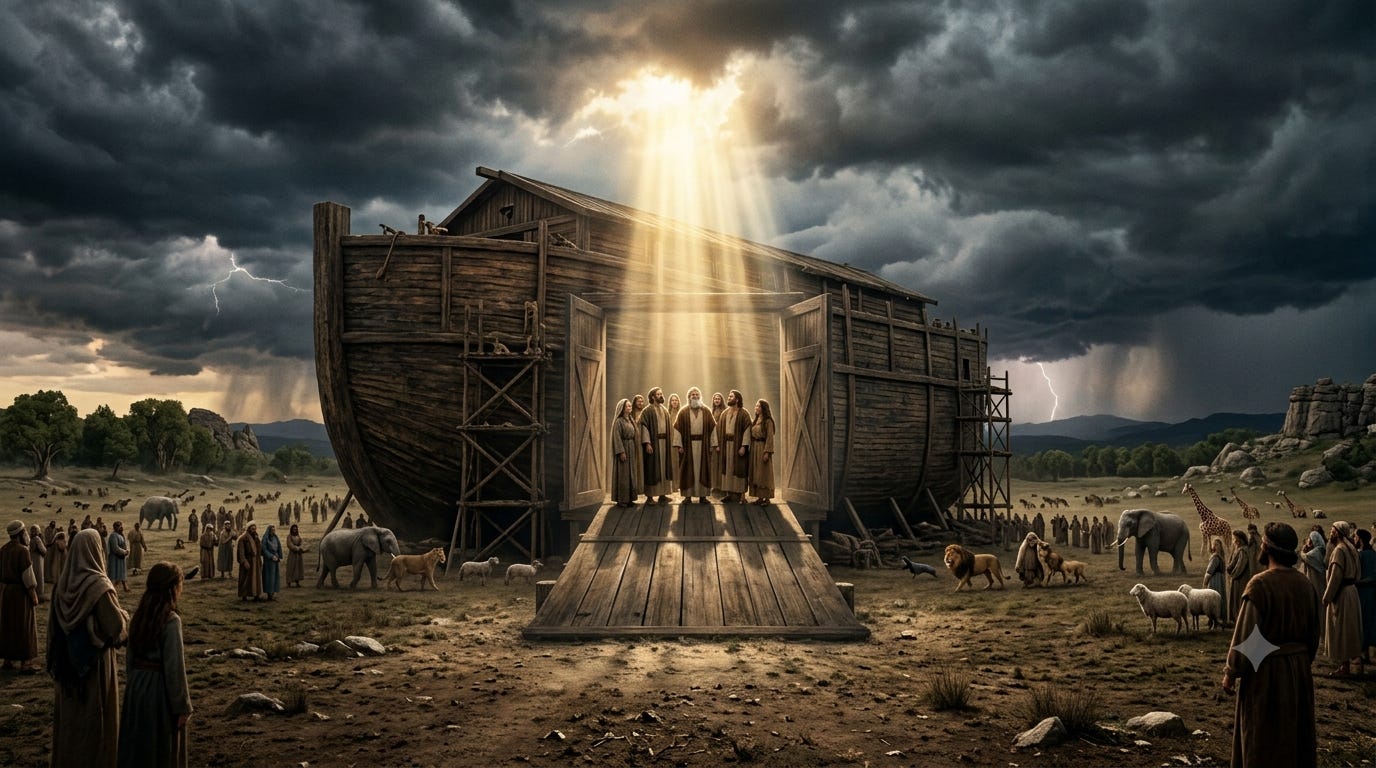
Genesis 7:11 LSB In the six hundredth year of Noah’s life, in the second month, on the seventeenth day of the month, on this day all the fountains of the great deep split open, and the floodgates of the sky were opened.
This is a literal de-creation.
The cosmic dams are breached. The waters from above and the waters from below, held at bay by the sustaining word of God, rush back together, swallowing the earth and returning the cosmos to its formless, void state.
The primary theological takeaway here is that the universe is not a self-sustaining mechanism.
The world exists, breathes, and maintains its boundaries exclusively because God wills it so. When human wickedness reaches a threshold that threatens to entirely corrupt the purpose of creation, God steps back, lifts His ordering hand, and allows the natural consequence of sin to overwhelm the earth. The floodwaters demonstrate that God’s justice is not an arbitrary tantrum, but a systematic cleansing, a hard reset of a defiled creation.
Monergism vs. Synergism: The Source of Noah’s Righteousness
For generations, human-centred (anthropocentric) theology has misread the opening of Genesis 7.
When God says to Noah, “Go into the ark, you and all your household, for I have seen that you are righteous before me in this generation” (Gen 7:1), the immediate temptation is to view Noah as a spiritual superhero.
The conventional narrative suggests that Noah looked at a corrupt world, independently chose to be good, and because of his superior moral stamina, won God’s approval.
This synergistic view (the idea that salvation is a cooperative effort born of human initiative and met by divine assistance) is thoroughly refuted by the broader witness of Scripture. Noah’s story is fundamentally a testament to Monergism: the truth that salvation, election, and regeneration are entirely the work of God alone.
To understand how Noah remained uncorrupted, we must track his lineage back to the dawn of Genesis.
Following the murder of righteous Abel by Cain, God appointed Seth to preserve a holy seed. Abel’s defining characteristic was his faith, manifested in offering his first and best to God, rather than his leftovers.
As generations progressed, the line of Cain built cities, accumulated wealth, and institutionalised violence, completely subverting the divine order. The line of Seth also faltered, eventually intermarrying and compromising until spiritual darkness enveloped the globe.
How did Noah escape this total systemic rot?
He did not achieve this through sheer human grit. Genesis 6:8 provides the indispensable key: “But Noah found favour [grace] in the eyes of the Lord.”
Grace preceded Noah’s righteousness.
God, with perfect foreknowledge, chose Noah before a single plank of gopher wood was cut. He did not wait for Noah to make a decision or volunteer for service.
God sovereignly separated Noah from his generation, called him out, and granted him the precise measure of supernatural grace required to preserve Abel’s faith. Noah did not decide to separate himself; God chose him, separated him, and enabled his obedience.
The 120-Year Crucible of Enabled Endurance
Once sovereignly separated, Noah was placed into a historical crucible that tested the absolute limits of human endurance.
God decreed that human civilisation had 120 years before the execution of judgment (Genesis 6:3). For over a century, Noah laboured on a gargantuan vessel far from any ocean, entirely guided by the invisible word of a holy God.
Consider the immense psychological and social toll of this assignment.
Noah was 600 years old when the task was completed. For 120 years, every blow of his hammer echoed as a visual and auditory sermon of warning to a civilisation that had never seen a global deluge.
The text implies an environment of relentless cultural taunts, mocking, and profound social alienation. Noah’s contemporaries undoubtedly viewed his construction project as the height of religious fanaticism and clinical insanity. To stand firm against the consensus of an entire global civilisation for over a century is a feat beyond human nature.
If Noah’s perseverance had been fuelled by his own independent stamina, he would have broken under the weight of the isolation within the first few decades.
His endurance is the ultimate proof of Monergistic grace.
The same God who sovereignly ordained the building of the ark was the very power animating Noah’s arms, shielding his mind from despair, and providing the supernatural fortitude to withstand the mockery of a doomed world.
The Eschatological Mirror: Matthew 24 and the Hubris of the Masses
The critical relevance of Genesis 7 for the modern believer is solidified by Jesus Christ Himself.
In His Olivet Discourse, Jesus explicitly connects the psychological and cultural landscape of the pre-Flood world to the closing chapters of human history:
Matthew 24:37-39 LSB “For just as the days of Noah were, so the coming of the Son of Man will be. (38) “For as in those days before the flood they were eating and drinking, marrying and giving in marriage, until the day that Noah entered the ark, (39) and they did not understand until the flood came and took them all away; so will the coming of the Son of Man be.
Jesus does not focus His warning on the graphic violence or grotesque sins of Noah’s day. Instead, He exposes something far more insidious: the hubris of absolute normalcy.
The pre-Flood population was entirely consumed by the mundane, earthly routines of life. They were buying, selling, building, marrying, and planning for distant futures with total, unwavering confidence in their own civilizational permanence. They looked at the sky, looked at the earth, and assumed that tomorrow would be exactly like today.
In this environment of total delusion, Noah alone possessed the terrifying knowledge of humankind’s imminent fate.
This knowledge was not a product of intellectual superiority or analytical foresight. Noah knew because God had uniquely shattered his blindness and unveiled the decree of judgment while judicially leaving the rest of the world to the Satanically inspired blindness.
When the day of reckoning arrived, Genesis 7:16 records a detail of immense theological comfort and sobering finality: “And the Lord shut him in.” (KJV and NKJV). The LSV renders this verse “and YHWH closes it for him”.
Noah did not pull the heavy door shut; God did.
The text transitions seamlessly from Elohim (the transcendent, powerful Creator who commands the animals) to Yahweh (the covenantal, deeply personal God who protects His people).
God Himself sealed the ark, permanently drawing the boundary line between the objects of His wrath and the objects of His mercy. Once that door was shut by divine decree, no human hand could open it for salvation, and no chaotic wave could breach it for destruction.
The Modern Parallel: The Syncretic Trap and the Isolated Remnant
As we observe the contemporary geopolitical and religious trajectory, the prophetic parallels to Genesis 7 and Matthew 24 become blindingly clear.
We are rapidly accelerating toward an era defined by identical civilisational hubris, in which the stage is being set for a massive global deception.
Scripture repeatedly warns that the final deception will not announce itself with overt, terrifying evil, but with the seductive promise of global peace, unity, and human brotherhood.
In a world deeply fractured by geopolitical wars, economic instability, and religious radicalism, the ultimate humanistic solution will be an appeal to total syncretism and the merging of all world religions into a single, unified global homogenised religion.
This coming system will likely be facilitated and validated by apostate global religious leadership, a compromised, highly influential authority figure, the first beast of Revelation 13, perhaps embodying the concept of a syncretic “American Pope”.
This figure will masterfully appeal to human pride, offering a “peaceful” world order where dogmatic truths are sacrificed on the altar of global solidarity. To the masses, this global ecumenical unity will look like the pinnacle of human enlightenment, an evolution of free will, and the long-sought salvation of humanity.
I can see the second beast of Revelation 13 forming as we speak. This topic, which has the Jesuit Catholic secret-society strategy all over it, is worthy of a thesis, but I will soon attempt an article on the Catholicisation of American politics from a historical perspective.
But just as in the days of Noah, the true, faithful remnant will be entirely isolated from this globally homogenised monoculture.
To refuse to bow to a syncretic world religion will not be viewed merely as an eccentric personal choice; it will be branded as an act of treason against humanity.
The remnant (those who insist on the absolute, exclusive lordship of Jesus Christ and the uncompromised Word of God) will face the full, concentrated fury of the global system. They will be labelled as intolerant, archaic, and dangerous obstacles to world peace.
The persecution of the end-times remnant will mirror the final days of Noah:
The Modern Taunt: Systematic public shaming, media demonisation, and intense psychological isolation. I have experienced this first-hand with the harassment of Matthew Adams of My Reason to Believe Substack in his attempts to shut me down. But his satanic taunts are nothing to what is coming.
Economic and Social Exclusion: Being completely cut off from the global infrastructure, unable to participate in the economic grid.
The High Cost of Truth: Just as the pre-Flood world was completely wiped out, the final faithful will face intense tribulation, with many facing the distinct probability of literal martyrdom.
Conclusion: Rest in the Sovereign Seal
If the survival of the end-times remnant depended on human grit, tactical preparation, or independent willpower, there would be no reason for hope.
The psychological weight of global alienation, coupled with the sophisticated apparatus of a unified world system, would easily crush the natural human spirit.
But the supreme comfort of Genesis 7 is that our preservation is entirely Monergistic.
The faithful remnant of the last days will not stand firm because they are inherently braver, wiser, or more spiritually resilient than those who capitulate to the global deception. They will stand firm solely because the sovereign God, in His perfect foreknowledge, has elected them, separated them, and infused them with the supernatural grace required to endure.
Just as God sovereignly preserved Abel’s faith in the heart of Noah, He will preserve His truth within His chosen people today.
We do not need to panic over the shifting tides of global politics or the betrayal of apostate religious leaders. Our security is not determined by the height of the chaotic waters, but by the strength of the One who built the Ark.
When the final deception peaks and Jesus calls time on the physical world, the modern remnant can rest in absolute peace.
The same God who called you out of the darkness will personally close the door, shielding you under His sovereign seal until the dawn of the new Jerusalem.
My Jesus-given purpose is to support the remnant. For a full explanation of this purpose, click this link.


